
Florida VINELink Custody Coverage
Florida VINELink provides a statewide entry point for a specific-person custody search and notification registration. It receives records from participating custodians. The public result may identify a custody status, the reporting agency, a location, an identifier, and available event information. What appears depends on the source record and the person's custody stage.
Coverage should be understood by custodian. A county jail record comes from that local system. A state-prison question should also be checked with the Florida Department of Corrections. Federal Bureau of Prisons custody does not belong in VINELink, and immigration detention has its own locator. Juvenile and other restricted records may not be available through the same public path.
The Florida person search is the direct place to begin a named lookup.
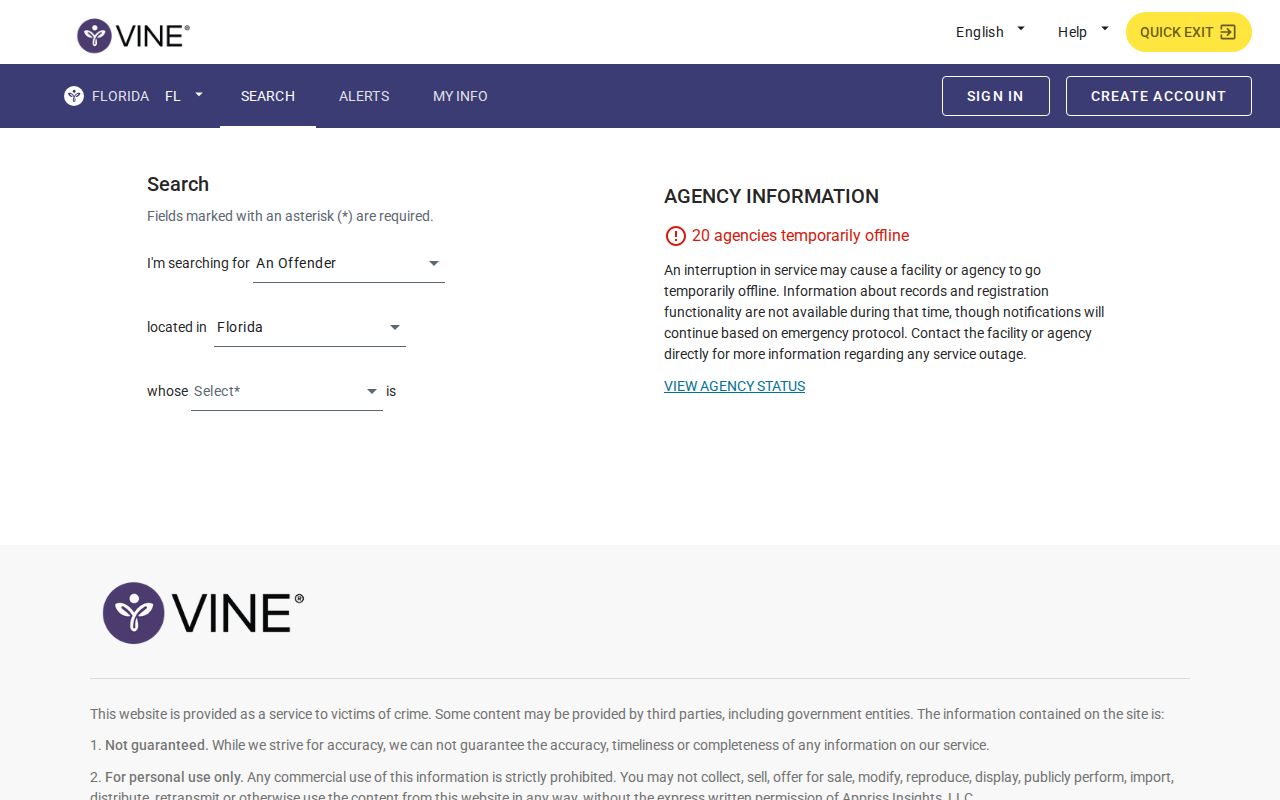
The screen is designed to find one record, so careful matching matters more than a broad list of recent releases.
Search Florida VINELink for One Person
Use as much reliable information as the search offers, but do not force a match. Name spelling, suffixes, aliases, and common names can create more than one result. The reporting agency is often the fastest way to separate them. If a known agency does not appear, return to the custodian's own system rather than treating silence as evidence of release.
- Open the Florida person search and enter the person's name or available identifier.
- Review the results for the correct spelling, identifier, custodian, and other public matching facts.
- Select the record tied to the expected Florida jail or corrections agency.
- Read the custody status and event wording exactly. Do not turn a transfer into a community release.
- Use the notification control only after the record match is sound.
- Confirm a reported release with the county records custodian or FDC release information.
If the person was held in a county jail, the county sheriff or corrections department remains the primary owner of the local record. Some Florida counties publish only a current roster. Others offer a short released-person list, a booking log with a release field, or a records-request route. There is no uniform county release feed for all sixty-seven counties.
For a state-prison case, search the same person through FDC's release information. FDC's DC number is the strongest match key when known. A released detail may retain Release Date and Date Out-Custody, while the separate supervision search may show that a post-custody term continues.
Note: Keep the exact custodian and status text because similar words can describe release, transfer, or another custody change.
Florida VINELink Release Fields
VINELink fields can differ because the reporting custodian supplies the source data. Read what the matched result actually shows. Do not assume a missing field has a negative meaning. A blank date may reflect the custody stage, source limits, or timing rather than a secret release.
| Field | How to read it |
|---|---|
| Name and identifier | Use them to distinguish the intended person from a same-name record. |
| Custody status | Preserve the displayed wording, especially for in-custody, released, or out-of-custody states. |
| Custodian or agency | Shows which office should confirm the event and provide the official record. |
| Facility or location | Identifies the reported placement, but a change may lag behind the agency's own record. |
| Event date | Connects a status change to a date when the source provides one. |
| Notification option | Opens registration for the events and contact methods offered on that record. |
A released or out-of-custody label should not be expanded beyond its source. It may establish that the named custodian no longer holds the person. It does not, by itself, prove that all supervision ended or that no other agency took custody. For FDC records, the released detail and supervised population search answer those separate questions more directly.
The FDC Inmate Release Information Search supplies the state-prison confirmation route.
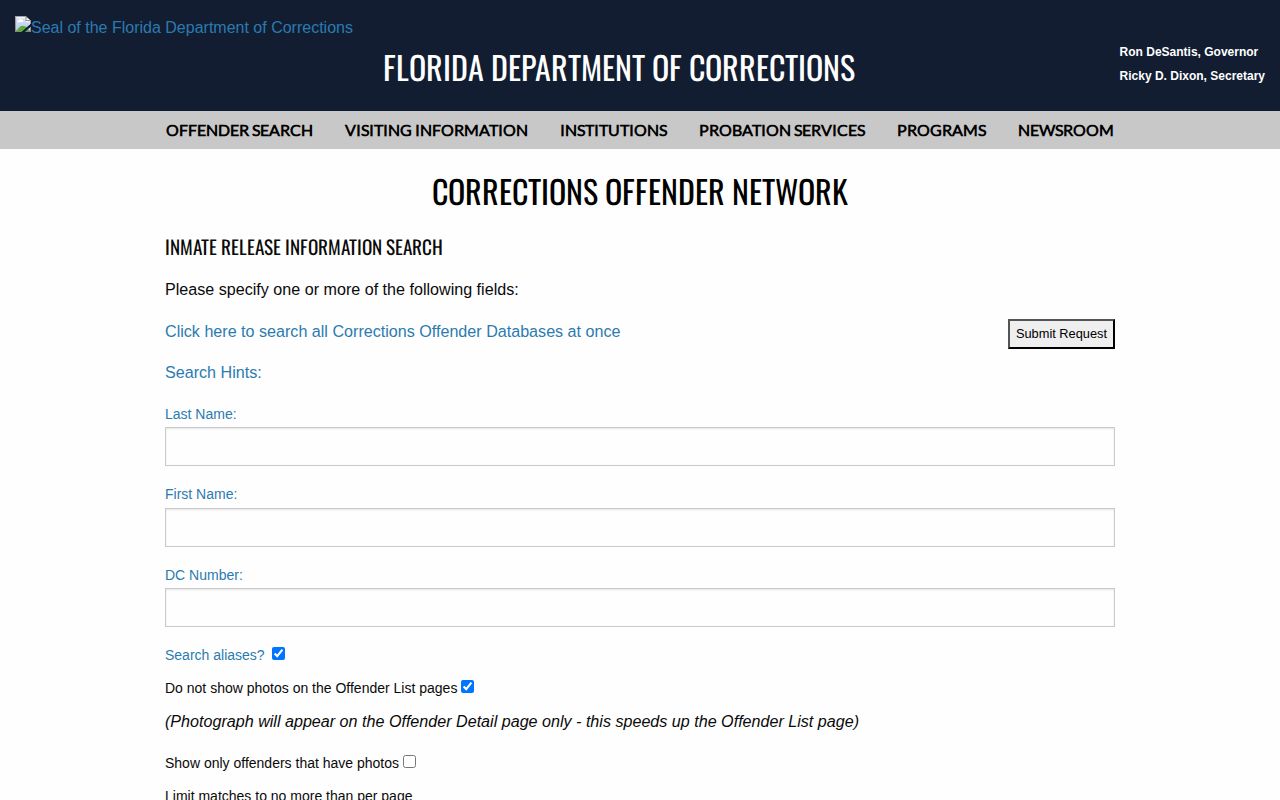
Its release-specific form avoids confusing a person who left state prison with someone who is still in the active population.
Register Florida VINELink Release Alerts
Registration begins from the correctly matched record. The control may be labeled Get Notified or use equivalent wording. Choose the offered custody event and contact method, then enter the required contact details. Complete each confirmation step. The information used to register is not part of the public inmate result.
- Open the matched Florida custody record and select its notification option.
- Review which events are offered, such as release, transfer, or another custody change.
- Select the available phone, text, or other contact method that fits the registration screen.
- Enter the requested contact information and create or record any required confirmation code.
- For telephone notification under FDC's form, choose the four-digit PIN used to confirm receipt.
- Save the registration details and update them through the proper service if the contact information changes.
The PIN is a response tool. FDC's registration form explains that a telephone call can continue until the recipient enters the selected four-digit PIN. The form also describes telephone and text options. Available VINELink controls can change with the record and interface, so follow the choices shown during the live registration.
The FDC notification form documents Florida's PIN and contact-method details.
The form is an FDC notification channel, while the VINELink record is a separate public custody-status and registration interface.
Note: Registration details are private, but the person search and public custody result remain separate from the alert settings.
Florida's Two Notification Paths
Florida has two related notification paths that should not be collapsed into one system. VINELink offers a specific-person custody search with event registration. FDC also maintains its own victim-notification request and registration materials. One public search result may be visible without any private registration, while alert contact information is entered for event-driven notice.
The FDC victim-notification request is the state corrections route described in the agency's materials. VINELink remains the statewide person-search entry point for participating custodians. A person may use the route that fits the custody record and eligible notification need, but neither interface replaces the custodian's release documentation.
This split matters when a public status and an alert arrive at different times. VINE is fed by participating agencies, so timing and fields can vary. FDC separately states update cycles for its corrections searches. A status difference calls for verification with the reporting agency, not an assumption that one screen is always wrong.
Question: Does registering for an alert change the public record? No. Registration selects notice for an offered event. It does not alter custody status, the agency's release decision, or the underlying record.
Florida VINELink Search Limits
A no-result can have several meanings. The custodian may not feed that record, the spelling may differ, the person may be under another sovereign, the data may be in transition, or public access may be restricted. County participation and interface details vary. Without a current official participation list that guarantees complete, real-time coverage, no statewide claim should promise that every Florida jail event appears at once.
| Situation | Next official source |
|---|---|
| Florida county jail | The county sheriff or corrections custodian, plus the sentencing county's clerk when a court order matters. |
| FDC state prison | FDC active, release, and supervised-population searches, followed by an FDC records request if needed. |
| Federal prison | The BOP Inmate Locator and federal district-court record. |
| Immigration custody | ICE Online Detainee Locator System and the relevant ERO field office. |
| Juvenile or restricted record | The responsible agency under the access rules that apply to that record. |
VINELink is not the BOP locator. BOP says its online locator covers federal inmates from 1982 to the present and may show a release date or wording such as Released or Not in BOP Custody. Those labels end the BOP custody question only. Federal supervised release, a transfer, and the case disposition may require other federal records.
ICE also uses a separate search. Its locator offers an A-number and country-of-birth route or a biographical route. A county jail transfer into immigration custody is not a full release from custody. If VINELink reports departure from the county jail, the next custodian still must be checked.
Timing also matters inside Florida's state system. FDC says its release information updates nightly, while much of the active and supervised population data follows a weekly refresh with key date and location changes updated nightly. VINELink receives data through its own participating-custodian flow. Two screens viewed at the same moment may therefore reflect different update points without proving that either event was false.
When results differ, save the exact wording, agency name, event date, and time of access. Then call or write the record-owning office for the dated source record. Do not merge fields from two people or two custody episodes to make the screens agree. A past county release and a later FDC admission can both belong to the same person, just as an FDC release and an active supervision entry can coexist.
Confirm Florida VINELink Release Results
For a county release, seek the dated release field, booking record, or release record from the county custodian. The trial-court clerk can supply a disposition, sentence, bond or release order, amended order, or violation case. Florida's ACIS is statewide for the Supreme Court and district courts of appeal, but it is not one name search for all circuit and county criminal files.
For a state-prison release, match the person in FDC's release information and record the Release Date plus any Date Out-Custody entry. Then check supervision. A closed incarceration record and an active supervision episode are not inconsistent. They describe different legal stages.
The FDC Supervised Population Information Search is the statewide follow-up after a prison release.
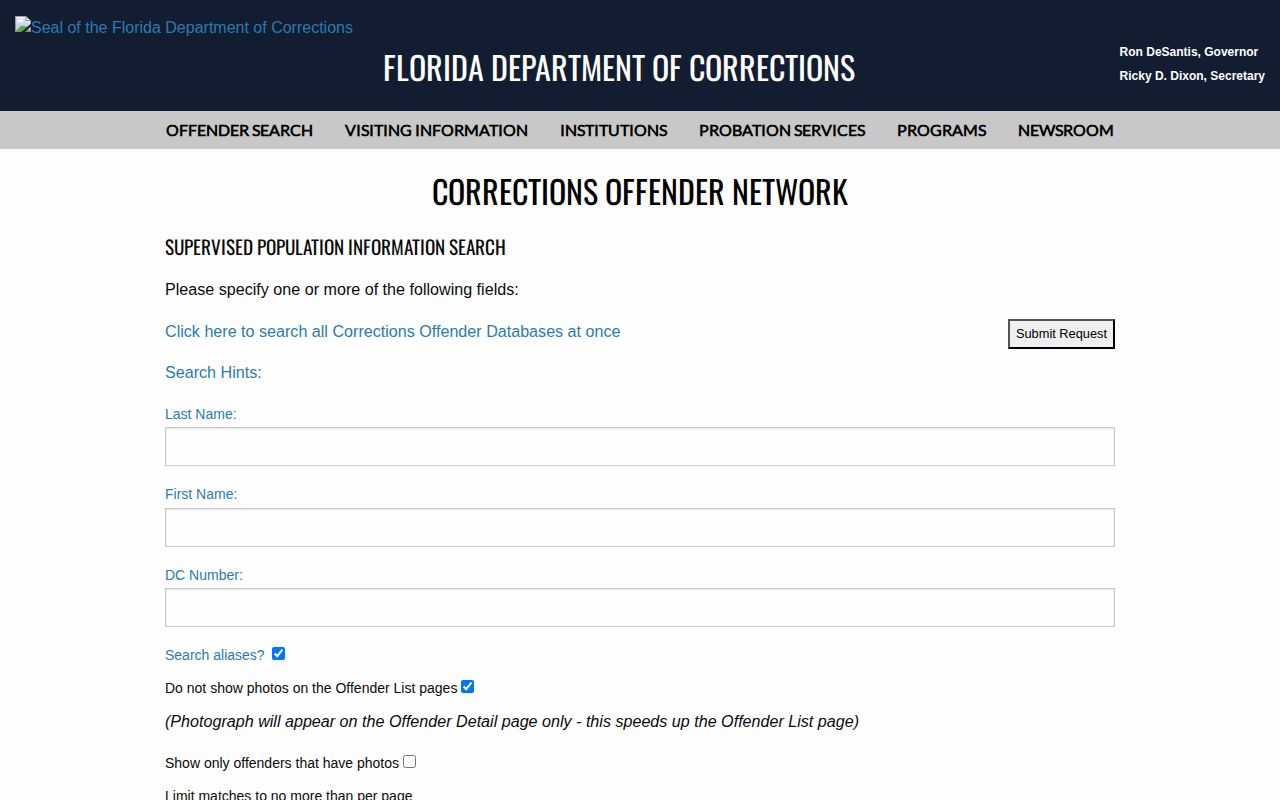
The result can show that physical custody ended while probation, parole, conditional release, community control, or another state status continues.
If the online facts remain unclear, make a focused public-record request to the agency that owns the event. Include the full name, the best identifier, the approximate custody period, and the precise record sought. Ask for release documentation or incarceration history rather than asking an agency to research an open-ended question. For county routing, the Florida County Directory points to the relevant local source.
Note: An alert is useful for timing, while a dated custodian record is the stronger proof of what legal custody event occurred.