
FDC Release Search Scope
FDC is the statewide custodian for sentenced state prisoners and for the community-supervision records it administers. Its public Corrections Offender Network is not one all-purpose roster. It offers distinct searches for current prison population, inmate release information, supervised population, and absconder or fugitive information. Other specialized searches also sit on the menu. The separation matters because physical release and the end of legal supervision can occur on different dates.
The FDC offender search covers felony offenders sentenced to state prison or state supervision. The release form expressly excludes county-jail and county-probation-only records. Someone who left a Florida county jail without entering FDC may have no FDC release result at all. In that case, the county custodian, trial-court clerk, and any other agency that received the person supply the record.
The Florida Department of Corrections website confirms the agency’s official FDC name and provides its main institutional and records routes.
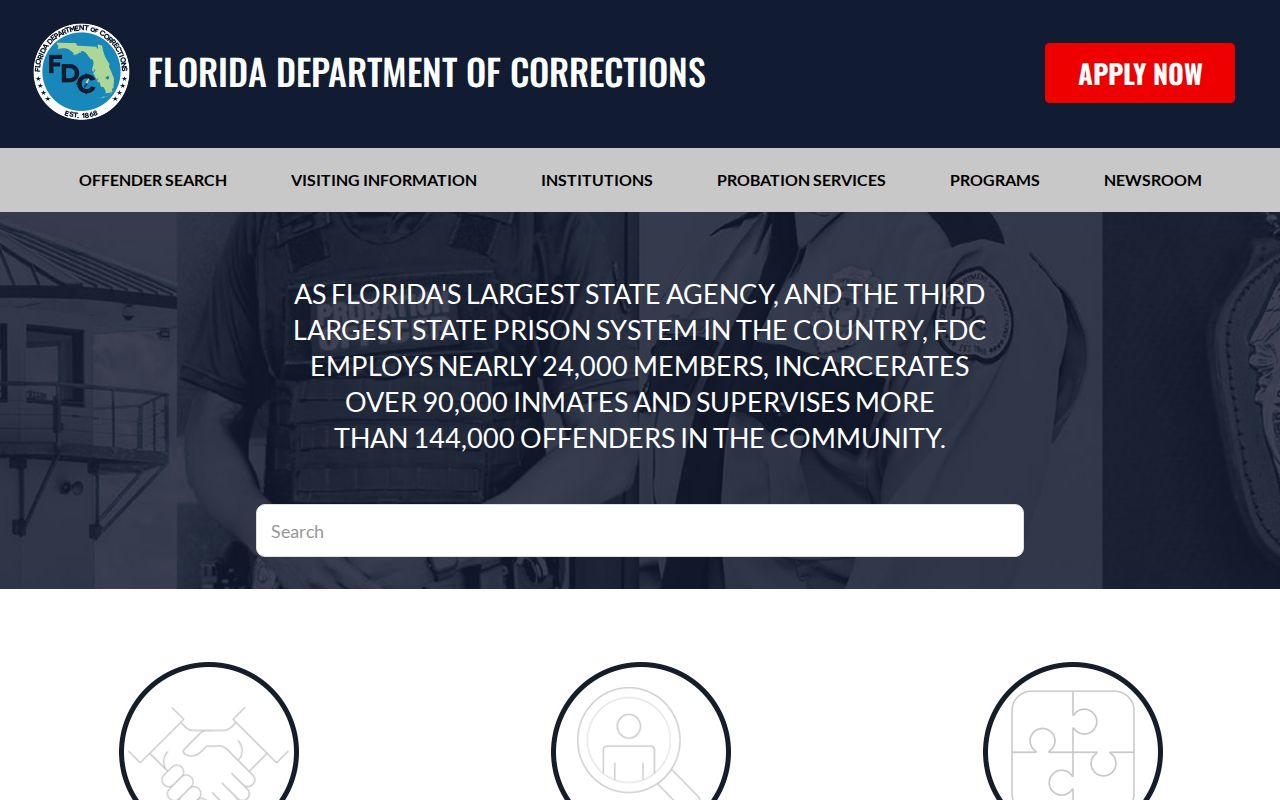
The offender databases are public applications linked from the agency, while focused record requests go through the FDC records process.
FDC Offender Search Choices
The Corrections Offender Network menu supports a four-part verification chain. Inmate Population Information asks whether a person appears in active state-prison custody. Inmate Release Information covers released people and people scheduled for release. Supervised Population Information checks post-custody supervision. Absconder/Fugitive Information addresses a distinct supervision status and is not another release record.
The FDC menu makes those choices visible before a user submits a name.
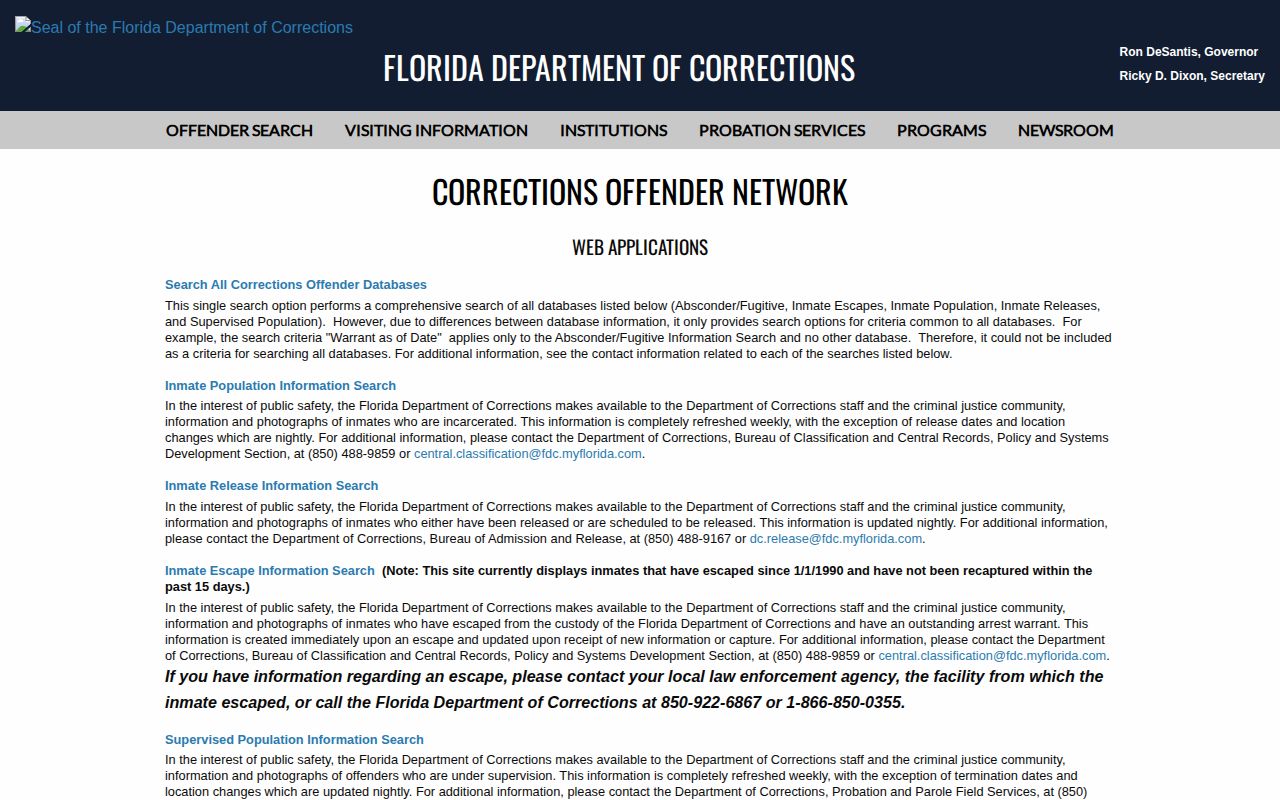
Choose the database that matches the question, then compare results across the other searches when the complete custody and supervision sequence matters.
- Active population
- People recorded in current FDC prison custody.
- Release information
- Historical releases plus scheduled future releases in the FDC database.
- Supervised population
- State-managed supervision such as probation, parole, conditional release, or community control.
- Absconder
- A person whom FDC reports as having left community supervision without authorization.
Use the FDC Offender Search
The released-person starting point is the official Inmate Release Information Search. Search by DC number when it is known. FDC defines the DC number as six characters, either six digits or one letter followed by five digits, and treats it as its primary identifier. Name search is useful when the number is unknown, but the detail must be matched with other identifiers because different people can share a name.
- Open Inmate Release Information, not the current population form.
- Enter the DC number, or use last name, first name, and available identifying filters. FDC supports prefix name matching and an alias option.
- Open the person’s detail rather than relying on the result-list row.
- Record
Release Date, each incarceration-historyDate Out-Custody, the last institution, and the offense and sentence data. - Search the same DC number in Supervised Population Information.
- When a public field is absent or uncertain, request the underlying FDC record.
The release form shows the name and DC-number routes used for the lookup.
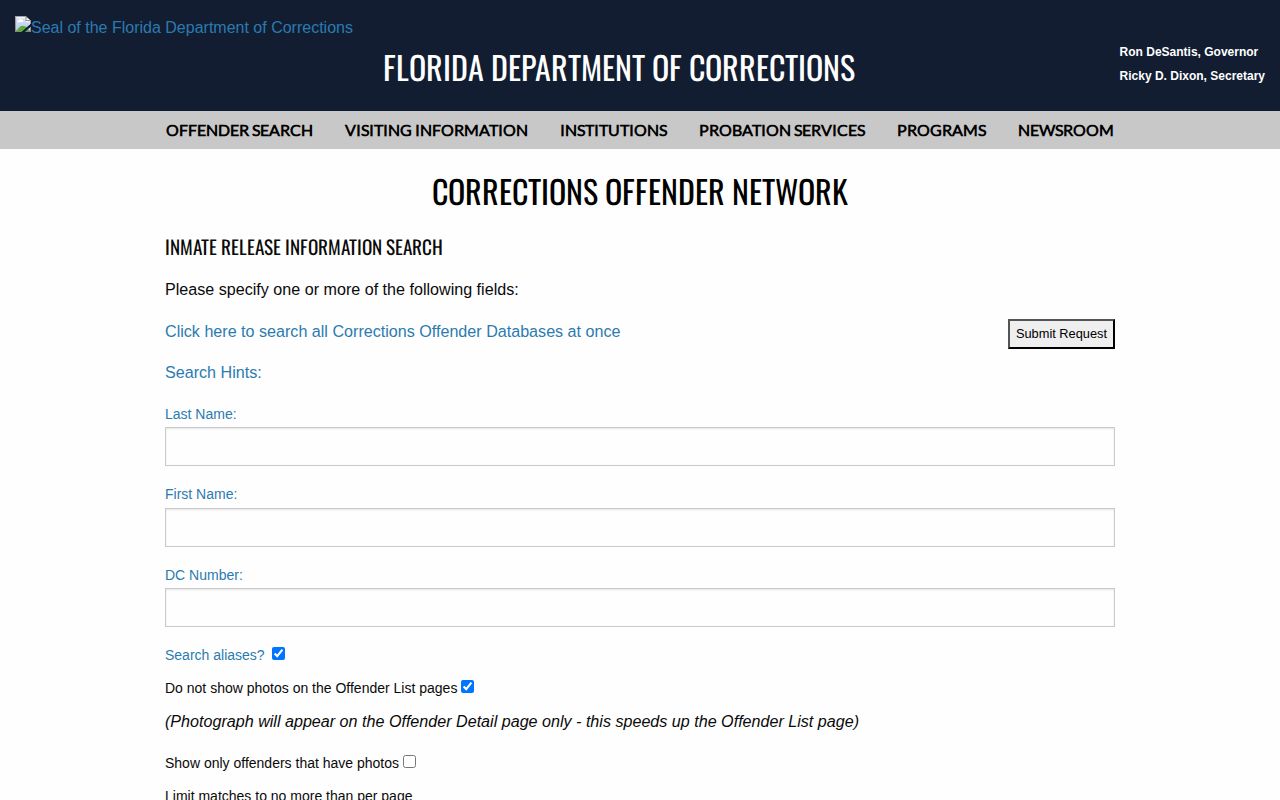
Broad name matching can catch an alias or spelling difference, but a same-name result should never be treated as conclusive without a reliable match.
Important: FDC includes scheduled releases in this database. A future date is not evidence that the person has already left custody.
FDC Released Inmate Fields
A released detail can retain a photograph, DC number, offense and sentence information, the headline release date, and an incarceration history. The public example uses Release Date for the main release-information date and Date Out-Custody for the close of an incarceration-history episode. Read the labels literally. Neither field alone proves that every reporting obligation, parole condition, or other agency’s custody ended.
| Field | Meaning and use |
|---|---|
| Last and first name | Release-form inputs with prefix matching for name searches. |
| DC Number | FDC’s primary six-character search identifier. |
| Alias option | Broadens the name query to include recorded aliases. |
| Name and photograph | Public result identifiers used with the DC number to avoid a same-name error. |
| Release Date | The headline date in Inmate Release Information; it may also be scheduled if future. |
| Date Out-Custody | The ending date tied to an incarceration-history event. |
| Offense and sentence | Connects the record to the relevant conviction and term. |
| Institution or history | Shows the FDC custody episode and its recorded movements. |
| Supervision result | Found in a separate search, not inferred from the release date. |
The public released detail demonstrates the exact release and out-of-custody labels.
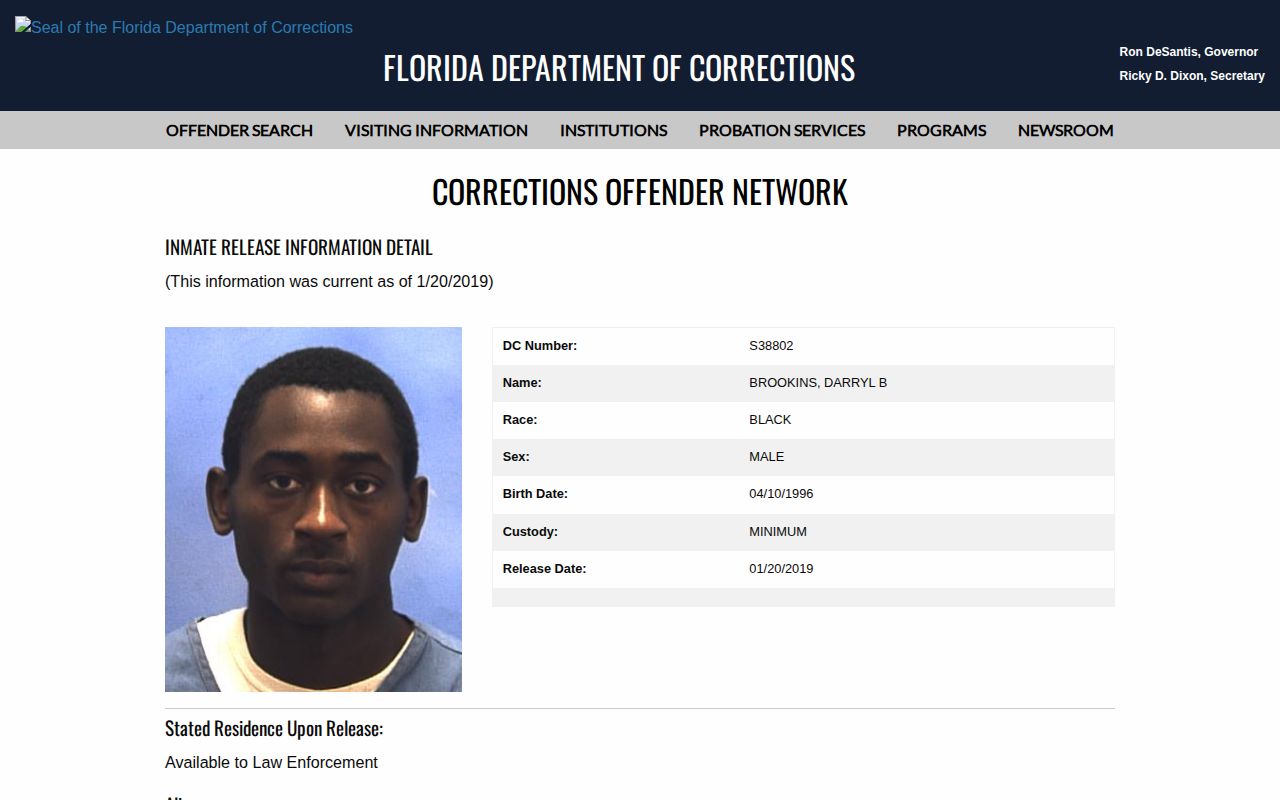
Keep a note of both dates and the event to which each belongs before checking what supervision followed.
Note: A transfer between FDC institutions is an incarceration-history event, not a community release.
FDC Release Search Updates
FDC describes different update rhythms for its public searches. Release information updates nightly. The active population database refreshes weekly, except release dates and location changes update nightly. Supervised-population termination dates and location changes also update nightly against a weekly database refresh. These schedules explain why two public views may not change at the exact same moment.
The release search visibly retains historical records, which makes it more useful for past custody than many current-only jail rosters. No reviewed official source promises that every public released record will remain online forever. When an older record is absent, the sound fallback is a focused FDC public-record request, not an assumption that the person was never in state custody.
FDC Release and Discharge
Florida records separate the end of physical custody, the start of post-prison supervision, and the final end of supervision. Parole exists mainly within Florida’s legacy eligibility framework rather than as the normal release mechanism for every modern prison sentence. Section 947.16 sets parole interview eligibility and exclusions. Sections 947.172 and 947.174 govern presumptive parole release dates and later review. A hearing date or presumptive date does not itself prove actual departure.
Conditional release is a separate post-prison supervision mechanism for qualifying cases. The Florida Commission on Offender Review uses categories that include parole interviews, parole supervision review, conditional release establishment, and conditional release supervision review. Preserve the category in the official record rather than calling every event parole.
End-of-sentence release follows the custodial term after lawful credits and adjustments. The FDC record still must be distinguished from a transfer, detainer pickup, court-ordered return, or handoff to another sovereign. The FDC event proves only what happened to FDC custody.
The public active-population detail shows the field labeled Current Release Date.
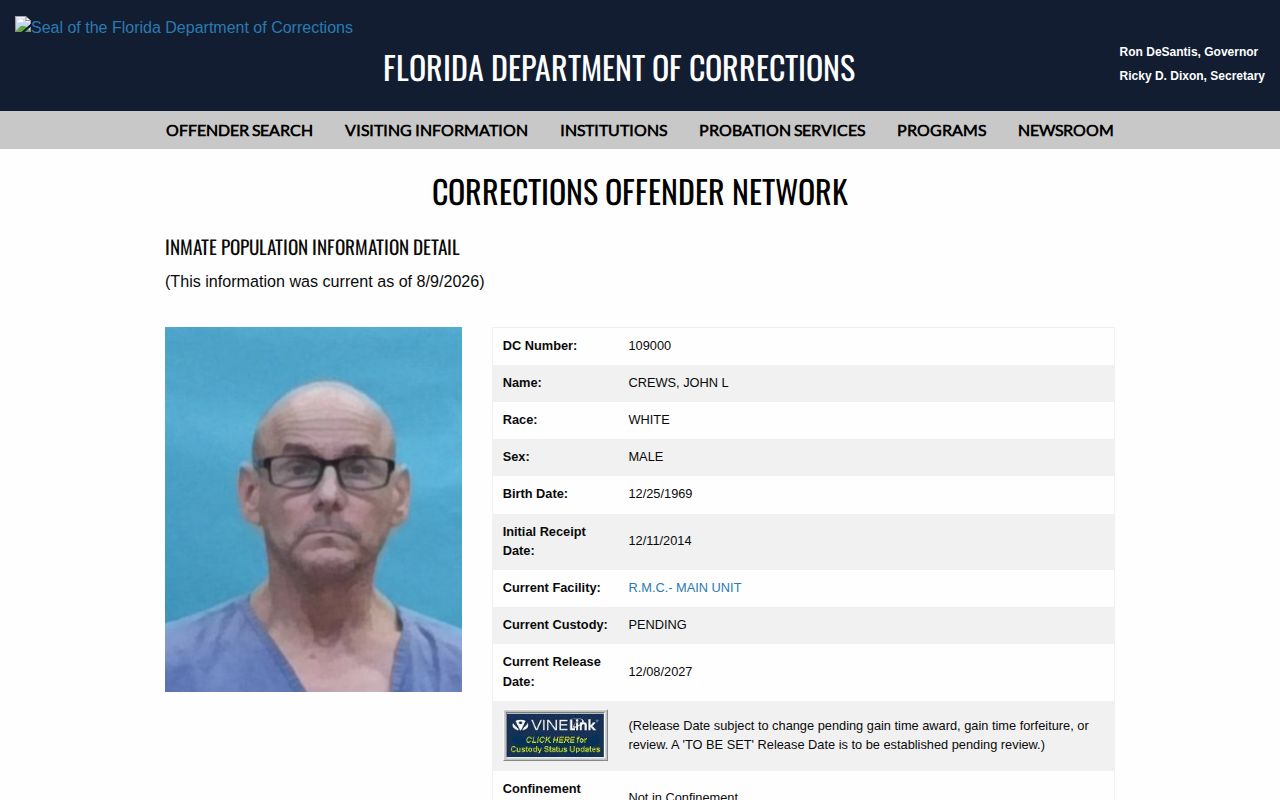
Florida law calls the calculated endpoint a tentative release date, and the public detail warns that the displayed date can change.
FDC Current Release Date
Section 944.275 directs FDC to establish a tentative release date by reducing the sentence through jail credit, other authorized credit, and gain-time. It distinguishes the maximum sentence expiration date from that tentative date. For offenses on or after October 1, 1995, the statute allows up to 10 days of incentive gain-time per month while imposing an 85-percent service floor for that class. Earlier offense-date bands use different rules.
The date can change when sentence data, jail credit, disciplinary forfeiture or restoration, a new court order, a detainer, or another lawful input changes. Section 921.161 governs county-jail credit before sentence. The court sets the sentence and awards applicable jail credit, while FDC administers gain-time under section 944.275. The safe method is to read the current FDC calculation and later confirm actual departure in Inmate Release Information.
Scheduled versus actual: Current Release Date is a changeable calculation. Release Date and Date Out-Custody document the release record after the event.
FDC Release-Day Records
FDC operates prisons, reception centers, work camps, and community-release or contract placements. A work-release or community-release placement remains an FDC status and is not final discharge merely because the setting is less restrictive. The release detail and any supervision result remain the statewide proof, while the last institution can confirm local property, funds, transportation, pickup, or transfer details.
Florida Administrative Code Rule 33-601.502 provides a $50 discharge gratuity for an eligible person released on parole, sentence expiration, pardon, or permanent court order, subject to the rule’s exclusions. For an otherwise ineligible person, the warden or designee may authorize up to $40 when the rule’s stated interests and circumstances support it. These provisions are not a promise that every released person receives $50. Rule 33-601.503 separately governs discharge transportation.
Section 944.605 adds specified pre-release notice, photograph, and identity-document duties. For qualifying Florida-born people released at sentence expiration, it addresses a certified birth certificate and state identification card or appropriate replacement driver license, plus assistance when a Social Security card is needed, subject to statutory exceptions.
Note: Confirm institution-specific release logistics with the last FDC facility because one statewide procedure cannot describe every release transaction.
FDC Release Trends
FDC counted 24,984 releases in fiscal year 2022–23, up 3.0 percent from the prior fiscal year. Of that total, 14,790, or 59.2 percent, were sentence expirations; 4,881, or 19.5 percent, entered conditional-release supervision; and 4,088, or 16.4 percent, went to probation or community control. The route mix is direct evidence that “released” does not mean “no supervision.”
| Fiscal year | FDC releases | Change in series |
|---|---|---|
| 2019–20 | 29,983 | Series high shown here |
| 2020–21 | 26,420 | Decline |
| 2021–22 | 24,247 | Further decline |
| 2022–23 | 24,984 | Modest rebound |
Across those endpoints, releases fell about 16.7 percent. The series is dated and should not be used as a current live total.
FDC Release Scale
FDC’s January 2025 report counted 87,978 people in prison, 145,374 under total community supervision, and 2,160 prison releases or expirations during that month. It separately identified 5,071 people on post-prison supervision. FDC defines post-prison supervision to include parole, conditional release, and program supervision, so total community supervision cannot be described as a parole count.
The monthly snapshot supplies scale, while an individual FDC offender search supplies the person-specific release evidence.
FDC Versus County Release
FDC offender search results cover the state-prison and state-supervision layer. Florida county sheriffs and county corrections agencies keep local jail records. A person released on bond from a county jail may never appear in Inmate Release Information. Conversely, a state prisoner’s FDC release record does not become a county jail release record merely because the prison sits within that county.
| Question | FDC state prison | County jail |
|---|---|---|
| Who is covered? | State prisoners and state supervision | People held by the local custodian |
| Release proof | Release Date and Date Out-Custody | County release or booking record |
| Follow-up | FDC supervision or FCOR action | Trial-court clerk and any receiving agency |
| Missing online record | FDC Public Records Center | County public-record request |
Federal prison belongs in BOP records, and immigration detention belongs in ICE records. Juvenile and forensic systems also need their own confidentiality-aware routes.
Request FDC Release Records
Use the FDC public-records page or its online Public Records Center when a search result is missing, ambiguous, or must be certified. Useful descriptions include release documentation, sentence data, incarceration and transfer history, a specified disciplinary record, or community-supervision termination documentation.
The public-record request page presents FDC’s statewide route.
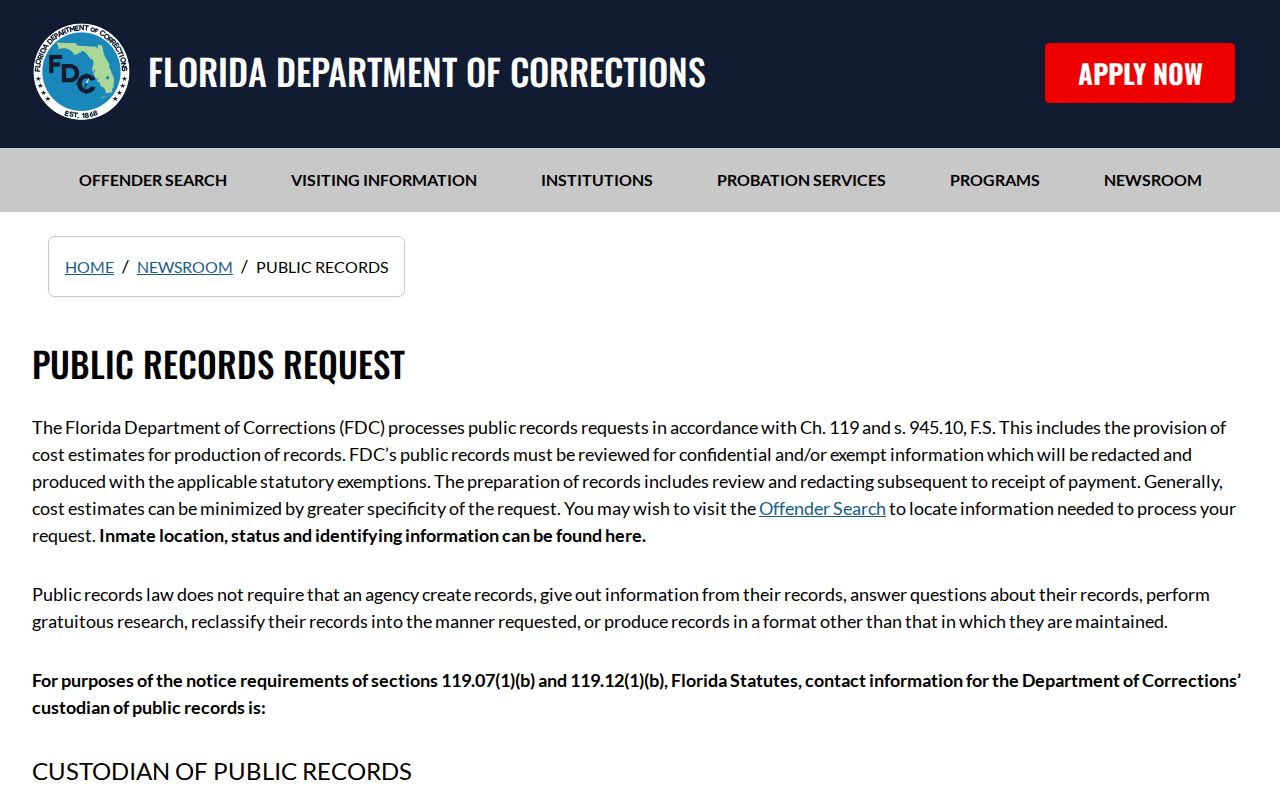
A focused request reduces the risk of delay or a broad cost estimate and makes clear which existing record should be located.
- Provide the person’s full name and DC number when known.
- Add a date of birth only when needed to distinguish people with the same name.
- State the approximate custody or release period.
- Name the precise record, such as a release summary, incarceration history, sentence data, or supervision termination document.
- Ask for electronic delivery and a cost estimate before extensive work.
Florida’s public-record framework permits redaction and fees allowed by law. FDC also explains that Chapter 119 does not require it to create a new record, conduct research, answer questions about records, or change a record into a format it does not maintain. Medical and education material can require added authorization and confidentiality review under section 945.10.
Verify an FDC Discharge
A complete check follows the record sequence instead of stopping at one screen. First, confirm the release detail and its date. Next, search Supervised Population Information with the same DC number. If a supervision issue appears, use the separate absconder search only as an agency-routing clue. Review the sentencing county’s clerk docket for the judgment, sentence change, release order, or violation proceeding. Obtain a final agency record when public fields do not settle the question.
Does “Date Out-Custody” mean the sentence ended? Not necessarily. It closes an incarceration-history event. A supervision termination entry, discharge certificate, FCOR order, or court order may be needed to establish the end of the next legal stage.
When a formal document is needed, name the exact event in the request. An incarceration release document addresses the end of FDC custody. A supervision termination record addresses the later end of FDC monitoring. An FCOR final action addresses the commission’s decision, while a clerk’s order addresses the court’s ruling. These records can fit together without being interchangeable. Matching the request to the agency and event also reduces the chance that a scheduled date, a calendar entry, or a closed custody episode will be read as a complete discharge from every obligation.
This sequence is slower than reading one roster row, but it preserves the exact agency meaning of release, supervision, and discharge.