
Florida Parole and Probation Compared
Parole and probation can both place a person in the community under rules, but they do not arise in the same way. Probation is a court-ordered sanction or part of a sentence. Parole is a form of post-prison release tied to Florida's legacy eligibility framework and action by the Florida Commission on Offender Review, often shortened to FCOR. Florida also uses conditional release, community control, program supervision, and other categories. Those labels should not be replaced with the broad word parole.
FDC's January 2025 statistical definitions show why the terms matter. The probation group includes probation categories, pretrial intervention, and community control. The post-prison supervision group includes parole, conditional release, and program supervision. A state report counted these populations separately. That method prevents a large probation count from being misread as the number of people on parole.
| Record type | How it begins | Best verification source | How it ends |
|---|---|---|---|
| Probation | A sentencing or other court order | FDC supervised-population record when FDC administers it, plus the sentencing court | Termination or discharge shown by FDC or the court |
| Parole | An FCOR action within the applicable parole framework | FCOR final action and FDC supervised-population record | Commission or FDC termination and discharge documentation |
| Conditional release | A qualifying post-prison release process | FCOR order and FDC supervision record | Termination recorded by the responsible agency |
| County supervision | A local court or program order | The sentencing county's clerk or local supervising office | A local completion, termination, or court order |
The FDC Corrections Offender Network menu makes these separate record tracks visible.
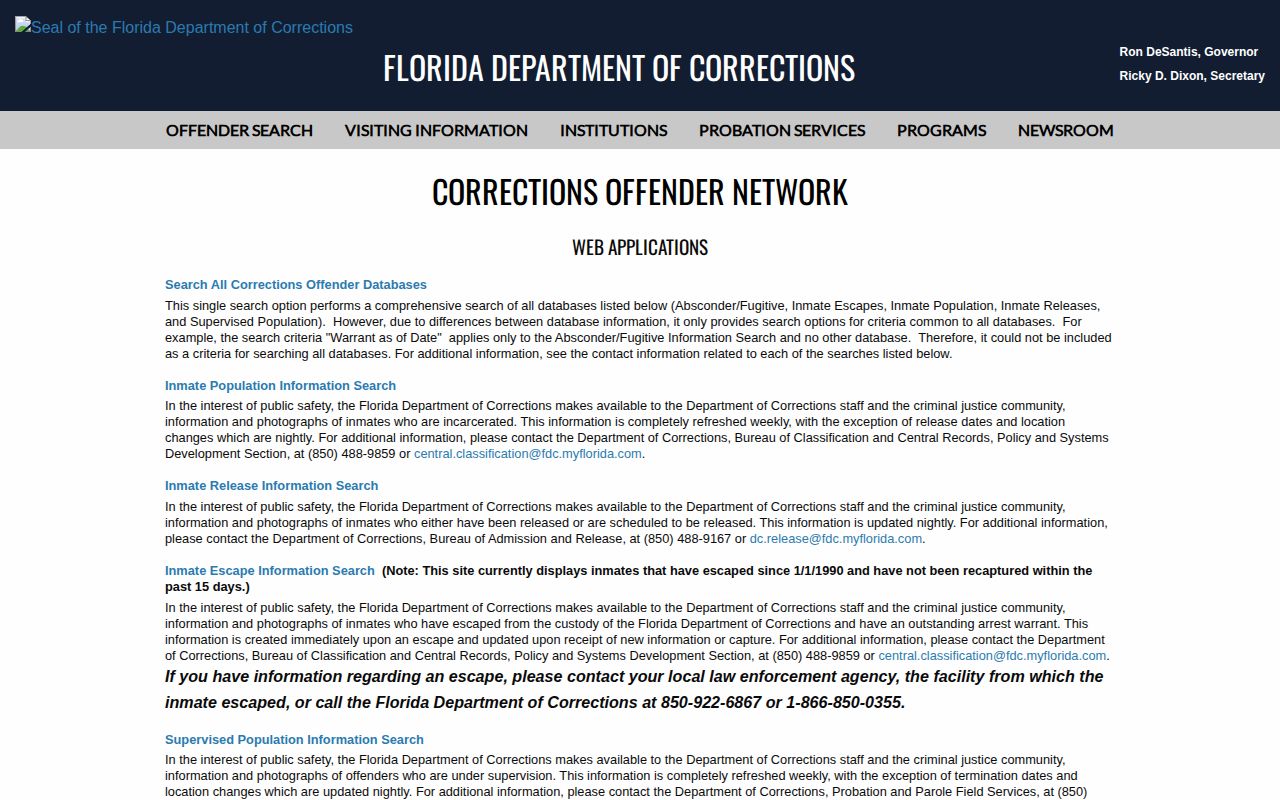
The menu is a useful reminder that one result cannot answer every custody and supervision question.
Verify Florida Post-Release Supervision
Begin with identity, not status. A DC number is the best matching key when it is known. Name searches can return more than one person, and spelling, suffixes, or aliases can complicate a match. Compare the public identifiers before reading any supervision detail. A closed incarceration episode and an active supervision episode can appear for the same person without conflict.
The statewide process is short, but each step serves a distinct purpose.
- Open the FDC Inmate Release Information Search and confirm the matching DC number, release date, and relevant out-of-custody event.
- Enter the same DC number in the FDC Supervised Population Information Search. If no number is known, use the available name and identifying filters.
- Read the supervision type and current status exactly as displayed. Note the start or termination information, office information, and any history supplied.
- If FDC shows no record, check the sentencing county's clerk. County misdemeanor probation and local pretrial release may sit outside FDC.
- When a formal end to supervision must be proved, request the termination entry, certificate, or order from FDC, FCOR, or the sentencing court that created it.
The official FDC Supervised Population Information Search is the statewide public starting point.
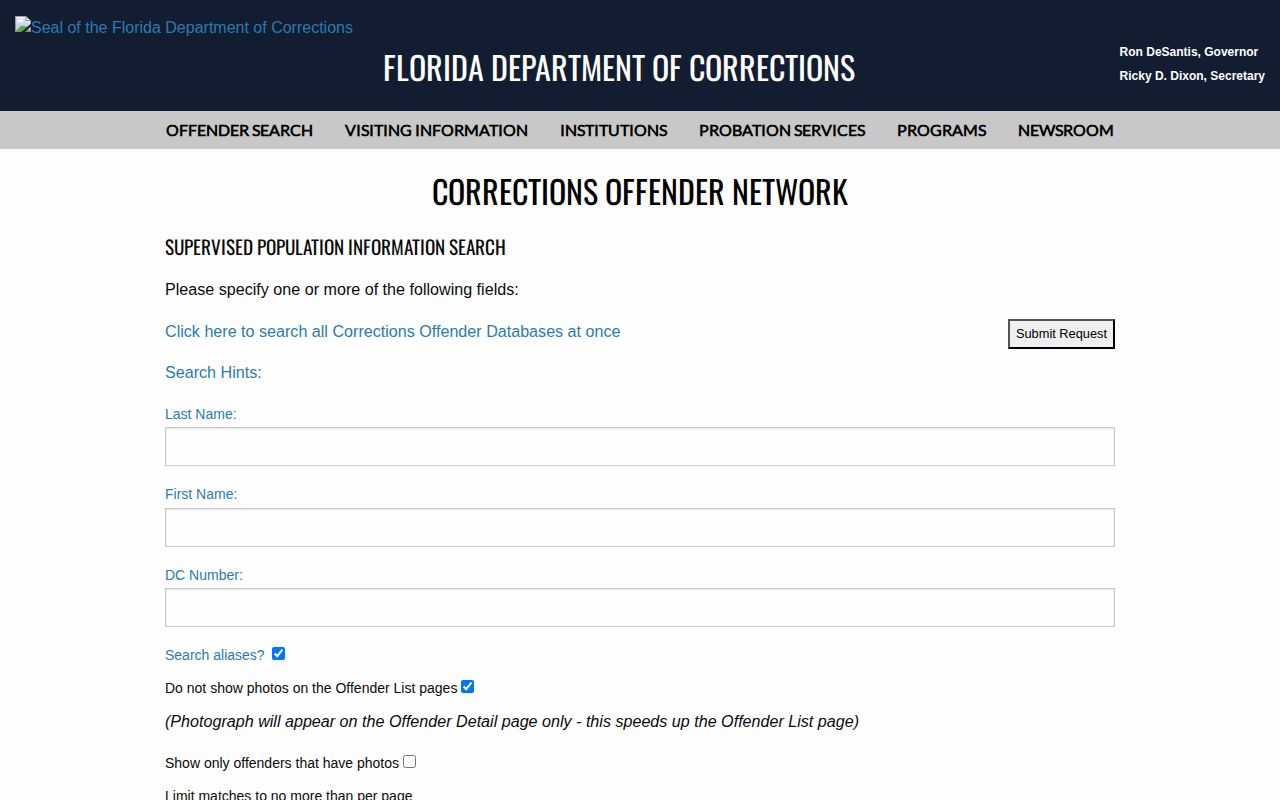
This form checks a supervision record after the release record has established the end of an FDC custody event.
Note: An absent FDC result does not rule out a county probation order, local pretrial terms, or another court-administered condition.
Read Florida Supervision Records
A supervision result should be transcribed with care. The key fields are the official type and status, the start and end or termination information, the listed office, and the displayed history. Do not turn a date into a conclusion that the source does not state. A planned termination date, for example, is different from a completed discharge entry.
- Parole
- A form of community release authorized through FCOR for people who fall within Florida's parole eligibility rules.
- Probation
- A court-ordered sanction served in the community under stated conditions.
- Conditional release
- A separate post-prison supervision mechanism for qualifying cases, administered through FCOR and FDC.
- Community control
- A highly structured form of community supervision included in FDC's probation group.
- Discharge
- The recorded end of the relevant supervision or sentence event, supported by the responsible agency's record.
- Absconder
- A person whom the supervising authority reports as having left supervision without authorization or stopped reporting as required.
These terms show why a general claim that someone is “on parole” can be wrong. The public record may identify probation, conditional release, community control, or another status instead.
Florida Supervision Agencies and Records
The Florida Department of Corrections maintains the statewide supervised-population search and the community supervision record it administers. FCOR is the state commission responsible for parole and conditional-release actions within its authority. The sentencing court remains essential when the question concerns the judgment, a local probation term, an amended order, or a violation case.
Official statewide routes
Florida Department of Corrections
Supervision lookup: Corrections Offender Network
Records route: FDC Public Records Center
Public-record information line: 850-717-9774
Florida Commission on Offender Review
Commission actions: FCOR voting schedule and agendas
Final orders: FCOR Public Records
For documents behind a public FDC result, the FDC Public Records Center accepts focused requests. A useful request identifies the person, DC number when known, approximate period, and the exact item sought, such as supervision termination documentation. Electronic delivery and a cost estimate can be requested. Exempt material may still be redacted.
Chapter 119 does not require FDC to create a new record or answer an open-ended question about records. Asking for a named document is more precise. The agency's public-record guidance also explains that focused requests can reduce cost estimates.
Florida Absconder Status Checks
FDC operates a separate search for people reported as absconders or fugitives from community supervision. That category is a supervision status, not a second prison-release event. It can provide a route to the responsible office or agency when the standard supervision record signals a problem.
Use the record as a verification clue. Do not approach the person. Questions about an active warrant, response, or safety belong with the agency listed in the record or the proper law-enforcement office. Public search data can lag a fast change, so an official agency response may be needed when the status is time-sensitive.
The separate FDC Absconder/Fugitive Information Search shows the correct statewide route.
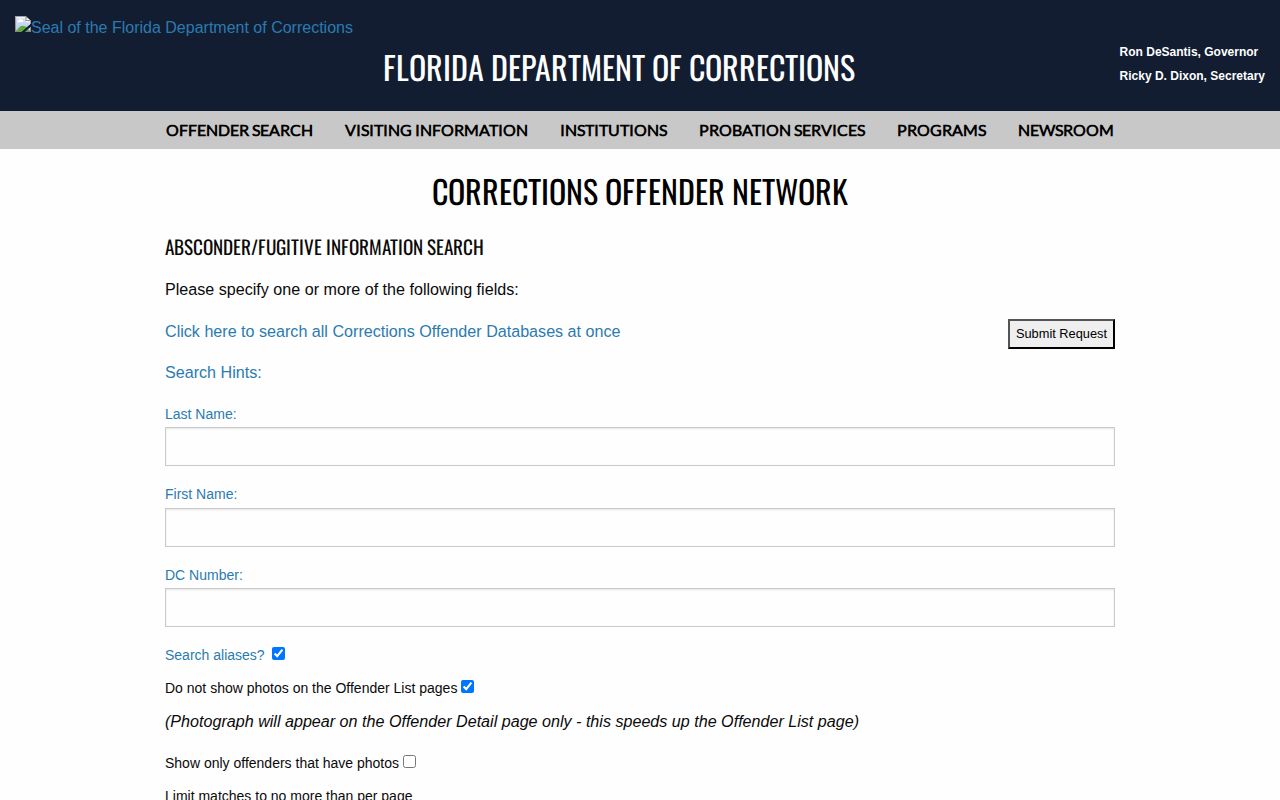
Its separation from the supervised-population form helps keep a noncompliance status distinct from release and discharge.
Note: An absconder listing is not permission to intervene; route verification and safety concerns to the agency shown in the official record.
Florida Release and Discharge Records
A Florida Release Date closes an incarceration event. It does not necessarily close the sentence or supervision term. This is the statewide distinction captured in Research Angle J. FDC uses separate release, supervised-population, and absconder searches because each database answers a different question.
First, confirm that physical FDC custody ended. Then look for a supervision episode. Finally, seek an actual termination or discharge entry when the question is whether supervision has ended. The sequence can be written as: custody record → release event → supervision record → termination or discharge record.
The FDC Inmate Release Information Search supplies the first statewide record in that chain.
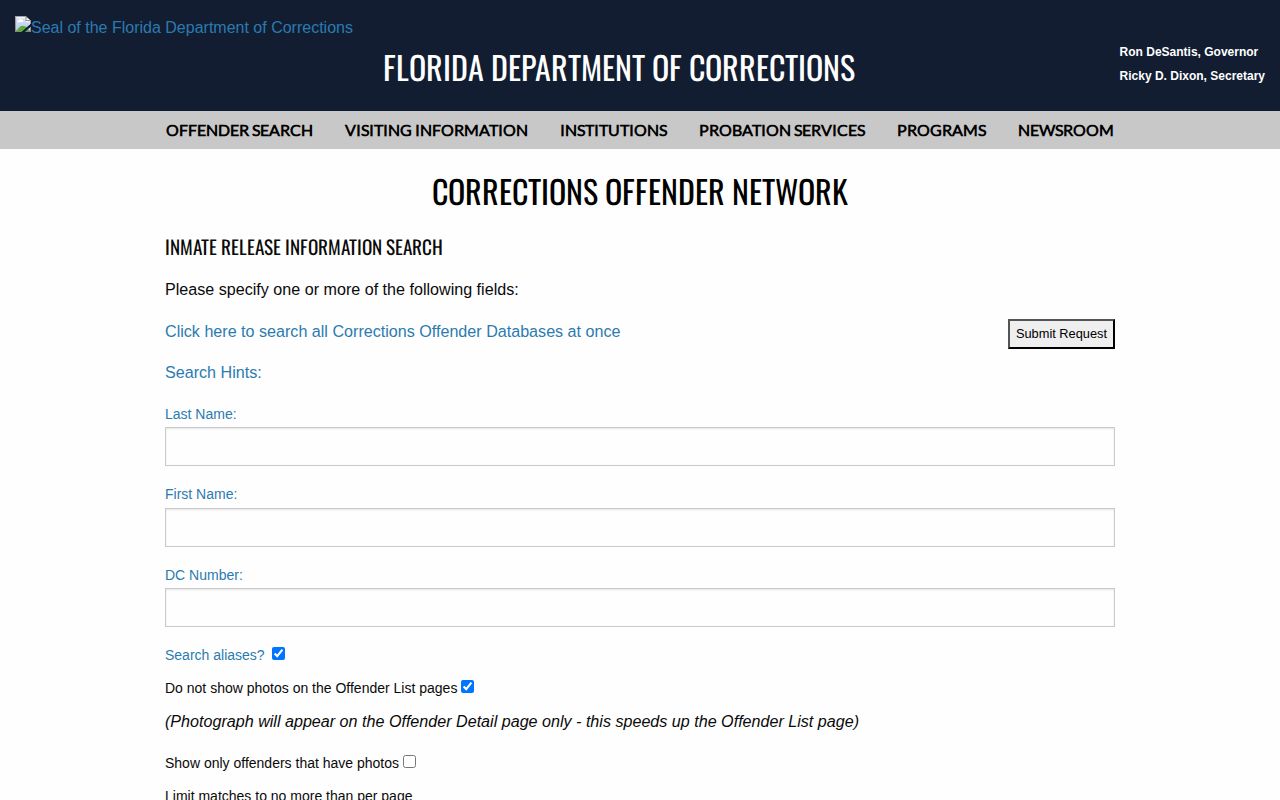
A matching release result should be followed by the supervision search, not read as proof that every legal obligation ended.
For a broader account of the custody record itself, the Florida released inmates search path explains how state, county, and court sources fit together.
Florida Supervision Terms and Violations
Conditions come from the controlling court or commission order and the supervision category. A public search may identify the type, status, and office, but it is not a full copy of the order. The filed judgment, FCOR final action, or agency record is the better source for exact terms.
A violation proceeding is also separate from the original release event. The sentencing clerk may hold the violation case or amended order. FCOR records may control a parole or conditional-release action. FDC holds the supervision information it administers. When sources differ, compare dates, DC number, case number, and the agency's exact status language before drawing a conclusion.
A current-custody roster should not be used as the sole check. A person can be out of prison and on active supervision, or may enter custody again after a violation. Each episode needs its own date and custodian.
Florida County Supervision Limits
FDC's public search is broad, but its own scope has limits. The department says its offender data concerns felony offenders sentenced to state prison or state supervision. A person whose case stayed at the county level may have no FDC release or supervision entry. That gap is expected in some cases and must not be turned into a claim that no court order exists.
County misdemeanor probation and local pretrial release can be run outside the state system. Start with the sentencing county when the state search has no match. The circuit or county clerk can provide the docket, judgment, probation order, later modification, violation filing, and termination order that are public and available. The local supervising office can address its own administrative record. Match the case number and date of birth or other lawful identifier rather than relying on name alone.
The difference also affects release research. A county jail roster tends to show current custody, and some counties publish a short released-person list or booking log. Those sources do not replace the court's probation order. Likewise, an FDC release record does not become the custodian for a county-only probation term. Route each request to the office that created the event.
Florida has no single public trial-court name search for every county case. The statewide appellate portal covers the Supreme Court and district courts of appeal, while ordinary criminal dockets remain with the relevant circuit or county clerk. The county name and case number are therefore key parts of a local supervision check.
Proving Florida Supervision Ended
A past release date is not enough to prove discharge. Look for the supervision termination information in FDC and obtain the certificate or order from the office that ended the term. Depending on the record, that may be FDC, FCOR, or the sentencing court. Keep the document date with the supervision type and case identifier so a closed term is not confused with a newer episode.
Ask for a specific document. Give the full name, DC number if available, the rough supervision period, and the record type. “Community-supervision termination documentation” is more useful than asking an office to research whether someone is completely free of all obligations. The custodian can produce an existing record, subject to exemptions, but does not have to create a legal conclusion.
If the term was county misdemeanor probation or another local program, use the county clerk and local supervising agency. The statewide FDC search expressly does not represent every county-only record. A dated order or termination entry from the correct source provides the soundest close to the verification chain.
Note: Match the discharge document to the same DC number, case, and supervision episode before treating the term as complete.