
Florida Parole Commission Records
Florida's parole authority is the Florida Commission on Offender Review, known as FCOR. Its work includes parole matters and conditional-release actions within the commission's legal authority. That role is narrower than all releases from Florida prisons. Most people shown with a future FDC release date do not thereby have a parole matter before FCOR.
The commission schedule, meeting agenda, and final action serve different purposes. A schedule gives the voting date. An agenda lists cases planned for that date and assigns a category. A final order or commission record establishes the action actually taken. FDC then supplies the custody and supervision records that show what followed.
| Official record | What it establishes | What it does not establish |
|---|---|---|
| FCOR schedule | A published commission voting date | That a named case appears or that a vote occurred |
| Dated agenda | A named matter was listed with a case category | The outcome or actual release |
| Final action or order | The commission's disposition in that matter | The date physical FDC custody ended |
| FDC release record | A Release Date and related out-of-custody history when posted | Every term of post-prison supervision |
The Florida Commission on Offender Review is the official starting point for commission identity and functions.
Find Florida Parole Hearing Dates
FCOR publishes a rolling online schedule with links to date-specific agendas. The live calendar can show meetings across successive weeks rather than one annual hearing day. Agendas may appear as the meeting approaches. Recheck the live record close to the expected date because an older saved copy may not reflect later scheduling changes.
Use the official calendar in this order:
- Open the FCOR voting schedule and scan the available meeting dates.
- Open the agenda linked to the relevant date once it is available.
- Find the person by name and confirm the DC number. Do not rely on a same-name match.
- Record the county, offense, case number, category, and whether the matter is marked for a panel or the full commission.
- Return after the meeting and request the final action when the result is needed. The agenda itself remains a pre-meeting list.
The official FCOR hearing and voting schedule displays the live calendar.
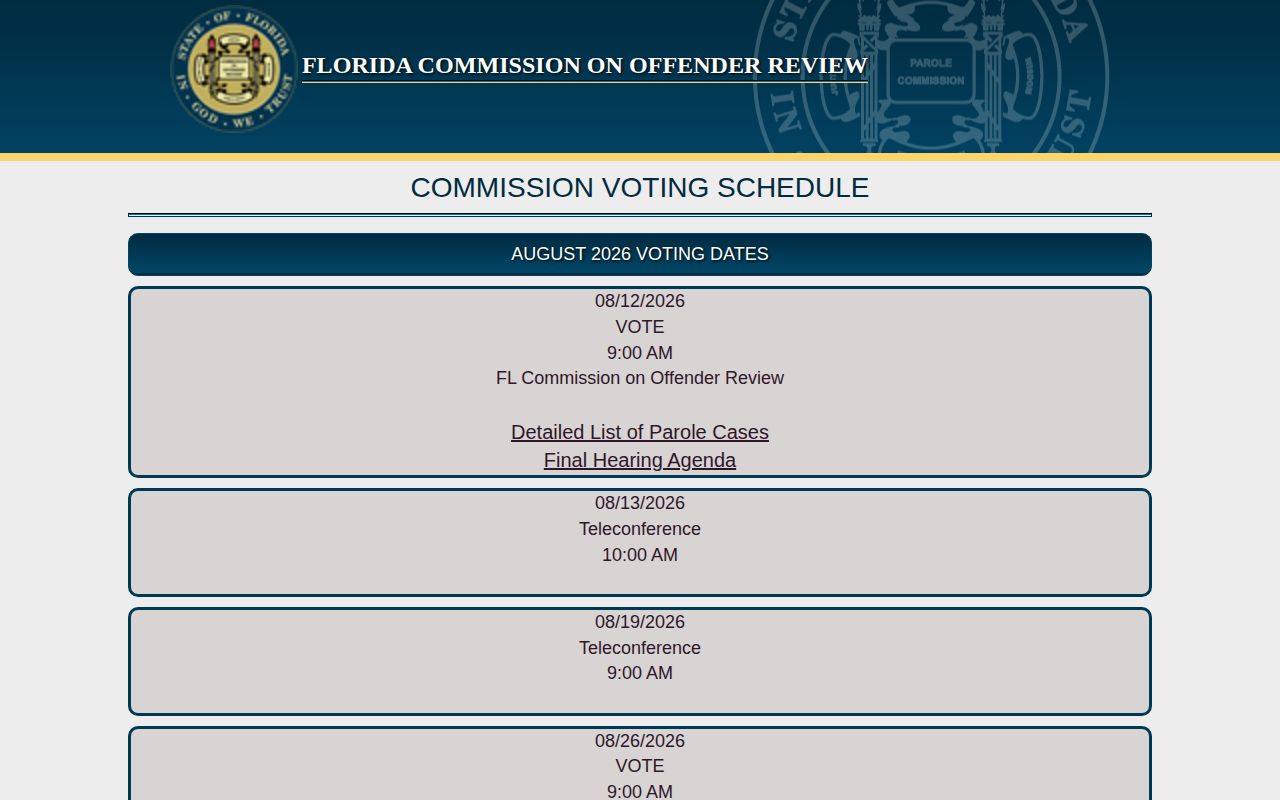
Each available date leads toward an agenda, but the calendar does not serve as a decision database.
Note: Check the live FCOR calendar again near the voting date because agendas populate and operational schedules can change.
Read Florida Parole Agendas
A dated FCOR agenda contains more than a list of names. Research found fields for the person's DC number, category, county, offense, case number, and the panel or full-commission designation. These details help distinguish people with similar names and tell the reader which kind of commission work is scheduled.
The category deserves close attention. FCOR agendas can distinguish an Initial Interview, Effective Interview, Subsequent Interview, Parole Supervision Review, Conditional Release Establishment, Conditional Release Supervision Review, revocation, and miscellaneous matters. Those entries are not interchangeable. A conditional-release review should not be reported as a parole grant, and a supervision review should not be called a first eligibility interview.
A public July 15, 2026 FCOR agenda illustrates the pre-meeting case-list format.
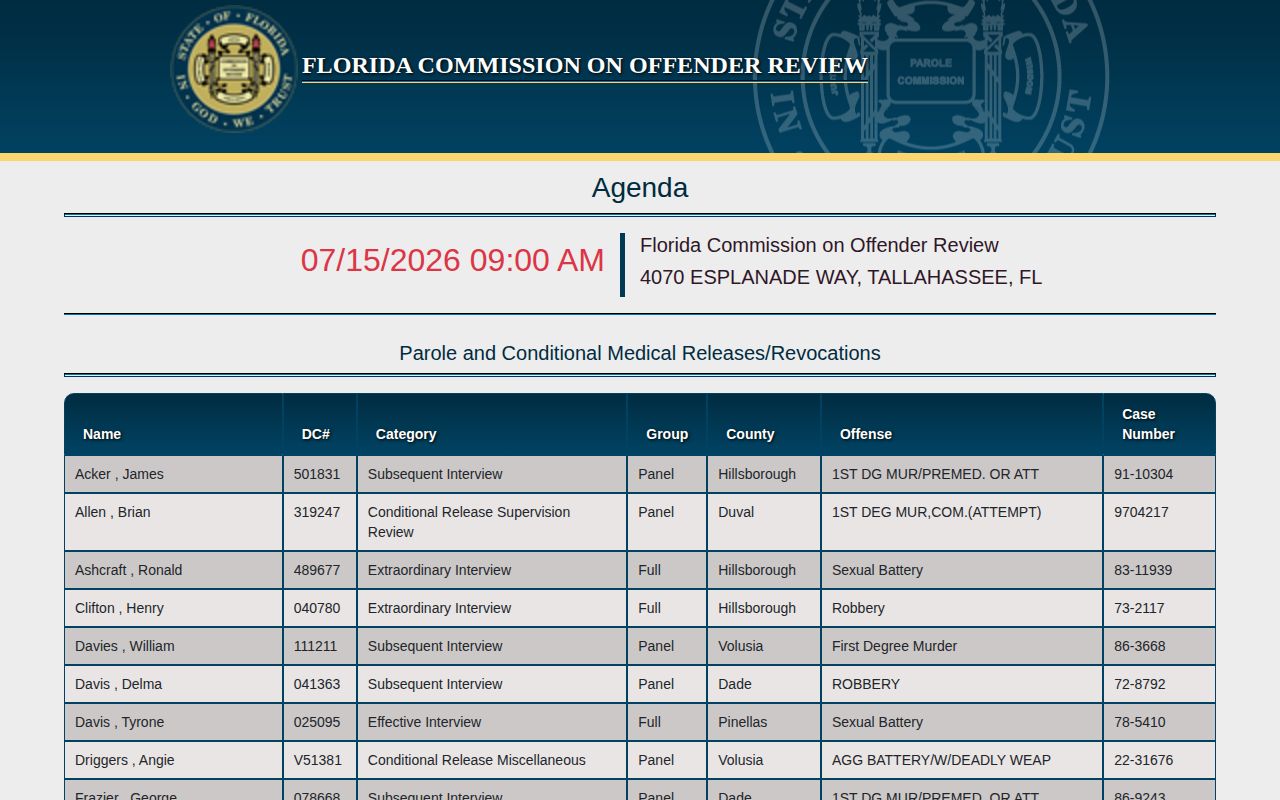
The agenda's value lies in its identifiers and category, not in any assumption about the later vote.
- Initial Interview
- An early commission review within the applicable parole process.
- Effective Interview
- A distinct FCOR agenda category that must be reported by its official label.
- Subsequent Interview
- A later review governed by the continuing parole process and applicable law.
- Supervision Review
- A matter about an existing parole or conditional-release supervision status, not a first release decision.
Find Florida Parole Decisions
No official public name-searchable FCOR decisions database was identified in the Florida research. That absence changes the correct search method. Do not infer a result from the disappearance of an agenda, an old calendar, an informal summary, or a future date shown by FDC.
The decision path uses the meeting details to request the actual commission record.
- Identify the meeting date and open its agenda.
- Copy the person's name, DC number, county, category, and case number exactly.
- Use FCOR Public Records to request the final action, order, or pertinent commission record for that meeting and case.
- Read the document's formal disposition and dates. Preserve the agency's terms rather than paraphrasing a technical action as release.
- Check the same DC number in FDC release information to determine whether a later out-of-custody event appears.
- Check the FDC supervised-population record when the commission action may lead to parole, conditional release, or another supervised status.
The official FCOR public-record request route is the documented channel for final actions and commission records.
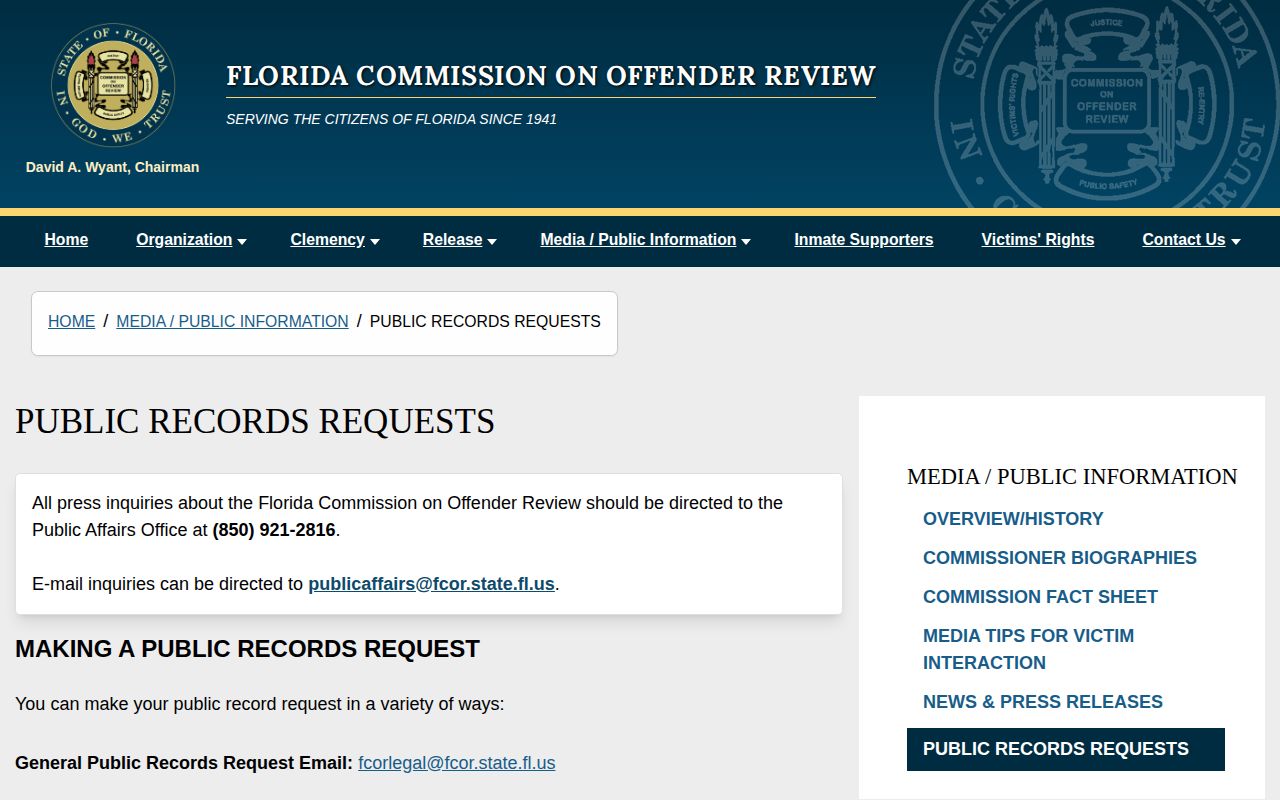
A focused request tied to the meeting and case is stronger than asking the commission to research an open-ended question.
Florida Parole Decision Terms
The final action controls the result. Common outcome words must be read in the context of that document, the case category, and any dates or conditions it sets. A short label alone should not be treated as a release certificate.
| Outcome term | Plain meaning | Next record to check |
|---|---|---|
| Granted | The commission approved the matter addressed, subject to the terms in its action | The full order, then FDC release and supervision records |
| Denied | The requested action was not approved in that decision | The order and any later review information it identifies |
| Deferred or continued | The matter was left for later action rather than finally resolved at that point | A later FCOR schedule, agenda, and final action |
| Rescinded | A prior action was withdrawn or canceled as described in the controlling record | The rescission record and current FDC custody status |
A grant may be one legal step toward release. It is not, by itself, a `Date Out-Custody` entry. Administrative processing, the terms of the order, and the resulting FDC record still matter. A denial also should not be used to invent the date of a future review; use the commission record and later schedule.
Note: Quote the disposition from the final FCOR action and keep it separate from the later FDC custody event.
Florida Parole Hearing Eligibility
Parole eligibility follows Florida law and the person's offense and sentence history. It does not arise merely because the FDC record shows a projected date. Florida parole chiefly operates within a legacy eligibility framework, so a modern prison sentence should not be assumed eligible without examining the controlling record.
Florida Statutes section 947.16 addresses parole interview eligibility and exclusions. Section 947.172 governs a presumptive parole release date, often shortened to PPRD. Section 947.174 addresses later interviews and review. Those statutes create a process, not proof that a person left prison.
A presumptive date is a commission concept within the parole framework. FDC's `Current Release Date` is a separate, changeable calculation in the active prison record. Neither should be silently substituted for the other. Match each date to its source, record type, and legal purpose.
Verify Florida Release After Decisions
A favorable commission action and an actual departure from prison are separate facts. After obtaining the final FCOR record, search the same DC number in FDC Inmate Release Information. A completed record may show a Release Date and an incarceration-history `Date Out-Custody` entry. A future release entry is not enough by itself because FDC says the release database includes people already released and people scheduled for release.
The public FDC released-record example demonstrates the two date labels used in a historical record.
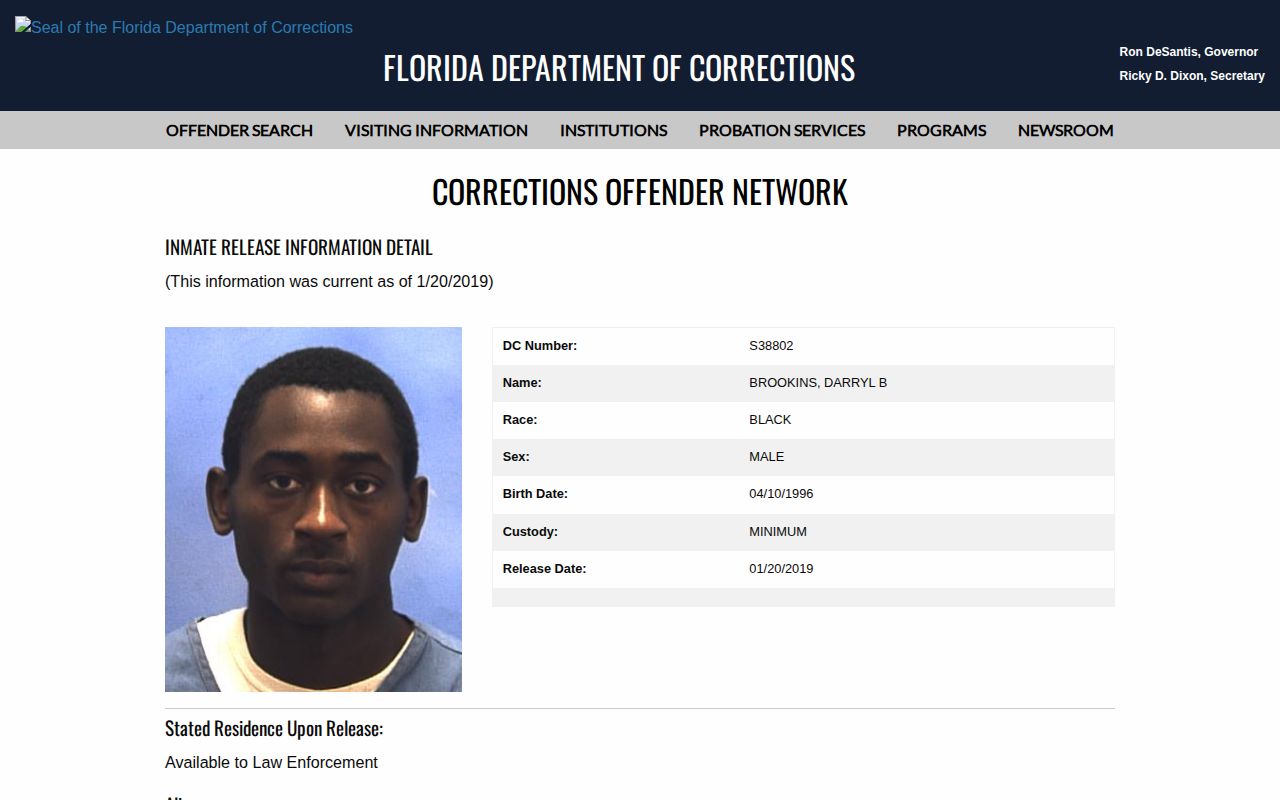
This type of FDC detail confirms the custody event, while the FCOR order remains the source for the commission decision.
Next, check FDC's supervised-population search. A person may have a closed incarceration episode and an active parole or conditional-release episode. Both entries can be accurate. The Florida probation and parole record process covers that post-custody check and the proof needed when supervision later ends.
Note: A future release entry requires a later check for an actual out-of-custody event and any supervision that began.
Florida Parole Dates Compared
Several official dates can appear during one Florida case, and each comes from a different decision process. The FCOR schedule date is when a matter is set for commission action. A presumptive parole release date arises within the statutory parole framework. FDC's `Current Release Date` is the department's current calculation for an active prison record. A `Release Date` or `Date Out-Custody` documents a release event when it is posted in the release record.
Keep a source label beside every date. Calling all four a “parole date” erases the very distinction needed to verify the outcome. A meeting can be continued. A commission action can set terms. An FDC calculation can change. The actual custody record can post after processing. No one date should be made to answer all four questions.
A simple chronology helps: court sentence → parole eligibility process when applicable → FCOR schedule and agenda → final commission action → FDC out-of-custody record → any FDC supervision record. Some cases will not pass through each stage. Modern sentences may have no parole eligibility, and an agenda category may concern supervision rather than a first release decision.
When the chronology breaks, request the missing record instead of filling the gap with an estimate. The sentencing clerk can supply the judgment and amendments. FCOR can supply its final action. FDC can supply release, incarceration-history, and supervision documents it maintains. Dates that differ may reflect distinct events rather than an error.
Florida Court and Parole Records
The sentencing record remains part of the evidence chain. A judgment, sentence, amended order, or violation case can explain why the commission matter exists and which sentence controls. Florida does not provide one official statewide public name search for all trial-level criminal cases.
The Florida Appellate Case Information System covers the Supreme Court and six district courts of appeal. It does not replace the circuit or county clerk for the ordinary trial case. Use Florida Courts' trial-court and court-location routing to reach the clerk in the sentencing county. Then match the case number and person to the FCOR agenda and final action.
When the records appear to conflict, compare the dates and the purpose each record serves. The court states the sentence. FCOR records its commission action. FDC records custody and the supervision it administers. The source with legal control over a given event should answer that event.
Request Florida Parole Hearing Records
A useful FCOR request identifies an existing record. Include the person's full name, DC number, meeting date, case number, and agenda category. Ask for the final action, order, or specified commission record. This wording lets the custodian locate the document without being asked to decide what happened as a general research question.
Florida's constitutional public-record right and Chapter 119 apply subject to exemptions and lawful redaction. An agency may provide the nonexempt part while withholding protected material. A request can also ask for electronic delivery and a cost estimate before extensive work begins.
Keep the requested document tied to the right agency. FCOR holds its decisions. FDC holds its release and supervision records. The sentencing clerk holds the trial docket and court orders. Combining those records produces a dated chain from eligibility and hearing through commission action, custody release, and any supervision that follows.
Note: Use the agenda identifiers in the request so the custodian can locate the correct commission action without relying on name alone.