
Florida Release Records Explained
“Released” describes the end of one custody event. It does not always mean that the person entered the community with no legal duty left. A county jail may release someone on bond, after time served, under a court order, or into another agency’s custody. The Florida Department of Corrections may end prison custody at sentence expiration or release a person to parole, conditional release, probation, community control, or another form of supervision. A transfer to FDC, federal custody, or immigration custody is not a full release from confinement.
The useful statewide sequence is custody end, possible supervision start, then supervision end. Each event can have its own record. For Florida released inmates from state prison, FDC supplies the custody date and its separate supervised-population search can show what followed. County sheriffs or county corrections offices keep local jail release data. The sentencing clerk supplies the order or case disposition that explains the legal basis. That separation prevents a roster absence from being mistaken for proof.
- Release
- The end of a specific jail or prison custody episode.
- Discharge
- The formal end of custody or supervision shown in the responsible agency’s record.
- Conditional release
- Post-prison supervision for a qualifying Florida case, distinct from parole.
- Detainer
- A request or legal hold that may send a person to another custodian.
The FDC Corrections Offender Network menu shows how Florida separates current prison custody, release information, supervision, and absconder records.
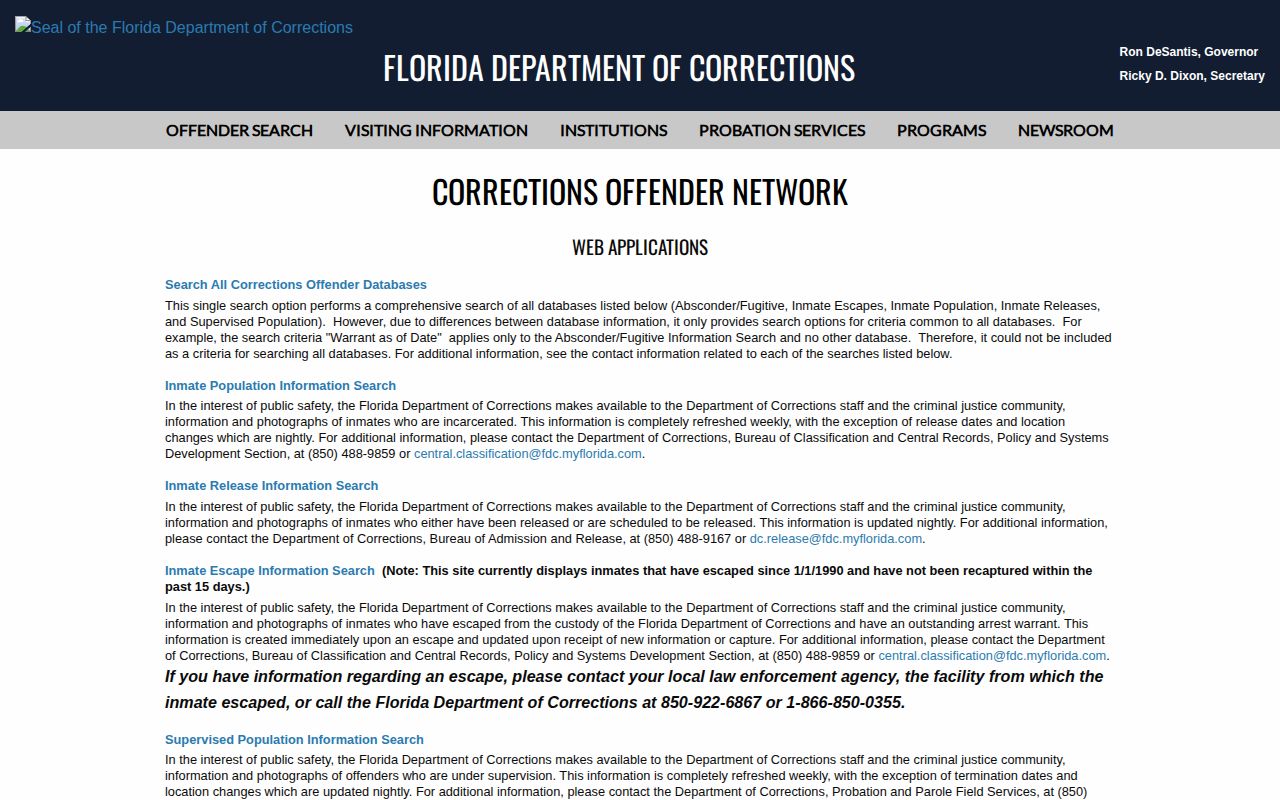
The separate choices are not duplicates. Each answers a different part of the release and discharge timeline.
How Florida Custody Ends
The record source follows the custodian and the event. Florida county jails handle pretrial detention and many short local sentences. FDC handles sentenced state prisoners and state community supervision. BOP and ICE keep their own federal records. The label on an agency record should be preserved because parole, probation, conditional release, transfer, and sentence expiration have different meanings.
| Event | Meaning | Best record |
|---|---|---|
| Bond or court release | Local jail custody ends under a court process | County custodian and trial-court clerk |
| Time served | A local or state custody term reaches its authorized end | Releasing agency and sentence record |
| State-prison release | FDC physical custody ends | FDC release information detail |
| Post-prison supervision | Custody ends but supervision begins or continues | FDC supervised-population record or FCOR order |
| Transfer or detainer pickup | One custodian releases the person to another | Both agencies’ records |
| Federal or immigration event | BOP or ICE custody changes | BOP locator or ICE ODLS |
Is a person free because a jail roster no longer lists them? No. Current rosters are built for people in that facility now. Check the dated release field, destination, court order, or receiving custodian before drawing a conclusion.
Florida Release Record Fields
A useful release record identifies the person, the custody episode, and its ending. County systems vary, so some show a release date and reason in a booking log while others require a focused public-record request. The FDC release detail may retain a photograph, DC number, offense and sentence data, a headline Release Date, and incarceration-history entries labeled Date Out-Custody. Those two date fields relate to release but should not be silently treated as proof that all supervision ended.
| Field | What it shows |
|---|---|
| Last and first name | FDC release-search inputs; names use prefix matching. |
| DC number | The strongest FDC search input, using six digits or one letter plus five digits. |
| Alias option | Broadens the release search when another recorded name may apply. |
| Custodian or facility | Identifies the agency or location tied to the event. |
| Release Date | The FDC release-information headline date or a local release date. |
| Date Out-Custody | The closing date for an FDC incarceration-history entry. |
| Release reason or type | May distinguish bond, expiration, supervision, transfer, or another route. |
| Sentence and offense data | Helps connect the release event to the correct case. |
| Supervision information | Shows whether a separate post-custody check is needed. |
The public FDC released-record example displays both the release headline and out-of-custody history.
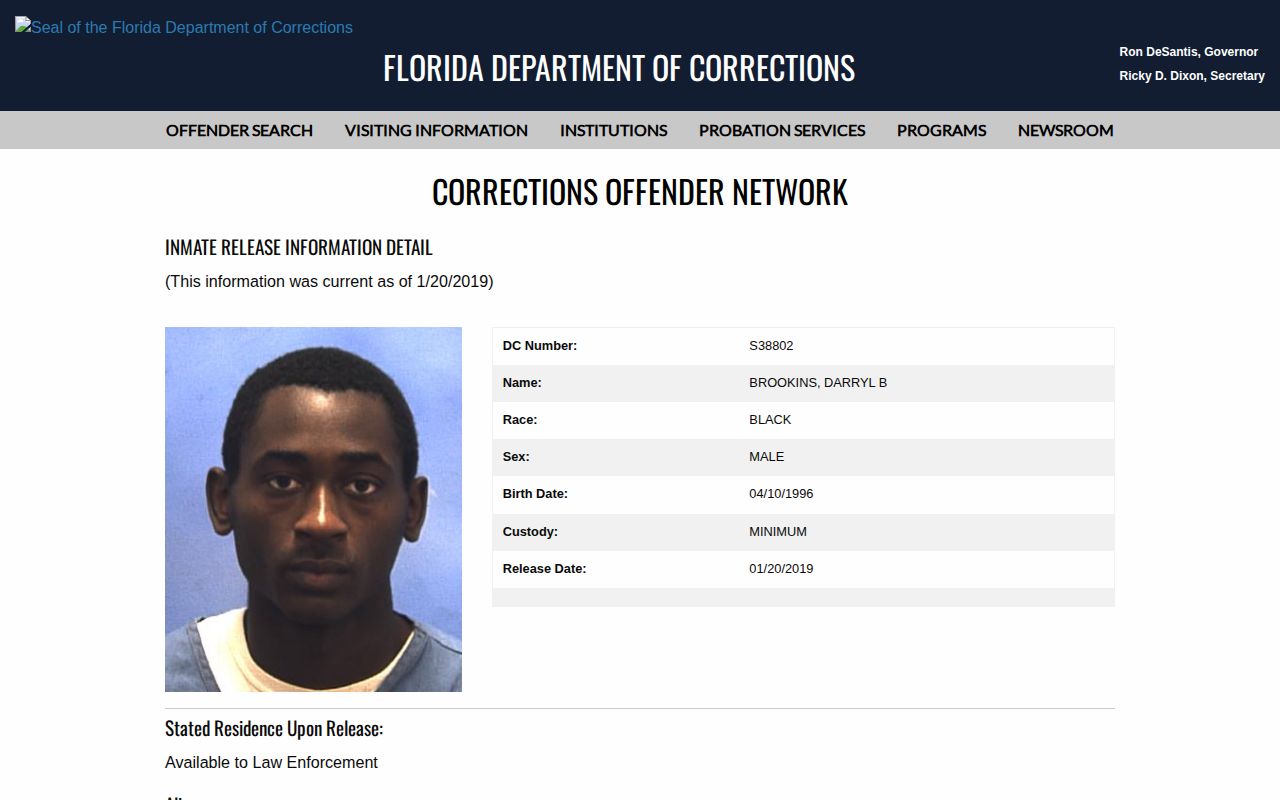
The field labels should be copied as displayed, then checked against supervision and court records when the full legal status matters.
Note: A future release entry is scheduled information, not proof that departure has occurred.
Request Florida Release Records
Florida’s Constitution, article I, section 24, and Chapter 119 establish broad public access subject to exemptions. Section 119.07 addresses inspection, copies, redaction, responses, and allowed fees. A narrow request works best. Ask for an existing release summary, incarceration history, sentence data, transfer history, or supervision termination record instead of asking the agency to research a broad question.
- Identify the custodian. Send county-jail requests to the sheriff or county corrections records office and state-prison requests to FDC.
- Give the full name, DC or booking number if known, an approximate custody period, and the exact record sought.
- Ask for electronic delivery when practical and request a cost estimate before extensive work begins.
- Review any redaction notice. Exempt portions may be removed while the rest is produced.
- Use the sentencing clerk for the judgment, amended sentence, release order, or disposition that the custodian does not maintain.
The FDC public-records page explains the state agency’s process and links its online Public Records Center.
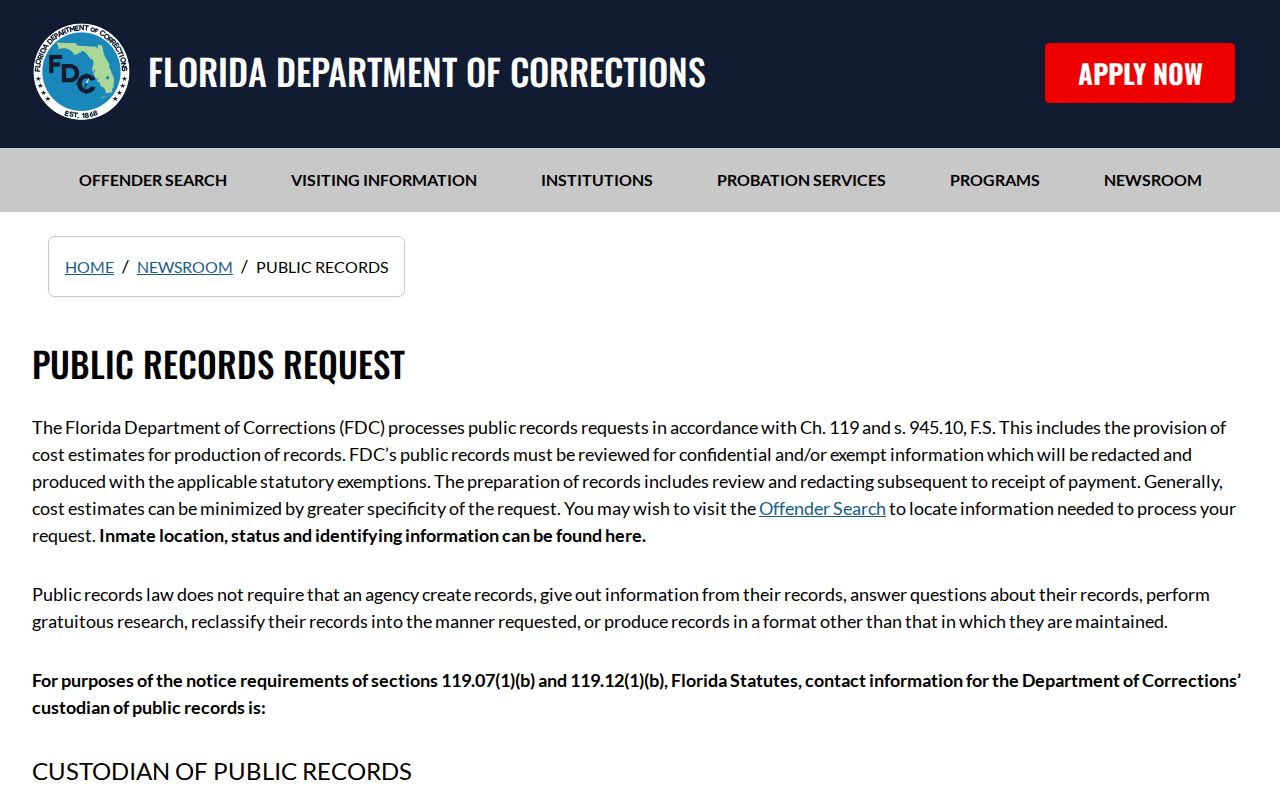
FDC notes that Chapter 119 does not require it to create a record, conduct research, answer questions, or convert a record into a format it does not keep.
Public-record rule: Access is broad, but it is not absolute. Juvenile, medical, education, sealed, expunged, and other exempt information may be restricted or redacted.
Florida Booking Photo Removal
Florida has a narrow law for commercial booking-photo publication. Section 901.43 lets a person whose booking photograph appears on a covered publisher’s site send the written removal demand described by the statute. The publisher must remove the image within the statutory period and cannot charge for that removal. This is not a general rule that every government photo or arrest record disappears after release.
The underlying sheriff, corrections, and court records remain governed by the laws that apply to those agencies. Sealing or expungement has its own legal process. For release verification, use the official dated custody record rather than a copied photograph or a private publication.
Search Florida Released Inmates
Start with the last known custodian. A sentenced state prisoner belongs in the FDC release database. A person held only in a county jail belongs with that county’s sheriff or corrections office and trial-court clerk. A federal prisoner belongs in BOP records. Immigration detention belongs with ICE. This source-first method avoids forcing every Florida release through a database that never claimed statewide county-jail coverage.
- Search FDC Inmate Release Information by DC number when known, or by name and identifying filters.
- Open the detail and record the exact release and out-of-custody labels.
- Run the same DC number through the FDC supervised-population search.
- For county custody, identify the county custodian and request its release or booking record.
- Check the sentencing clerk for a release order, amended sentence, or case disposition.
- Use BOP or ICE when another sovereign held the person.
Important: A released person normally leaves a live roster. Roster absence alone may also reflect transfer, data lag, death, or another custody change.
The FDC Inmate Release Information Search is the state-prison starting point.
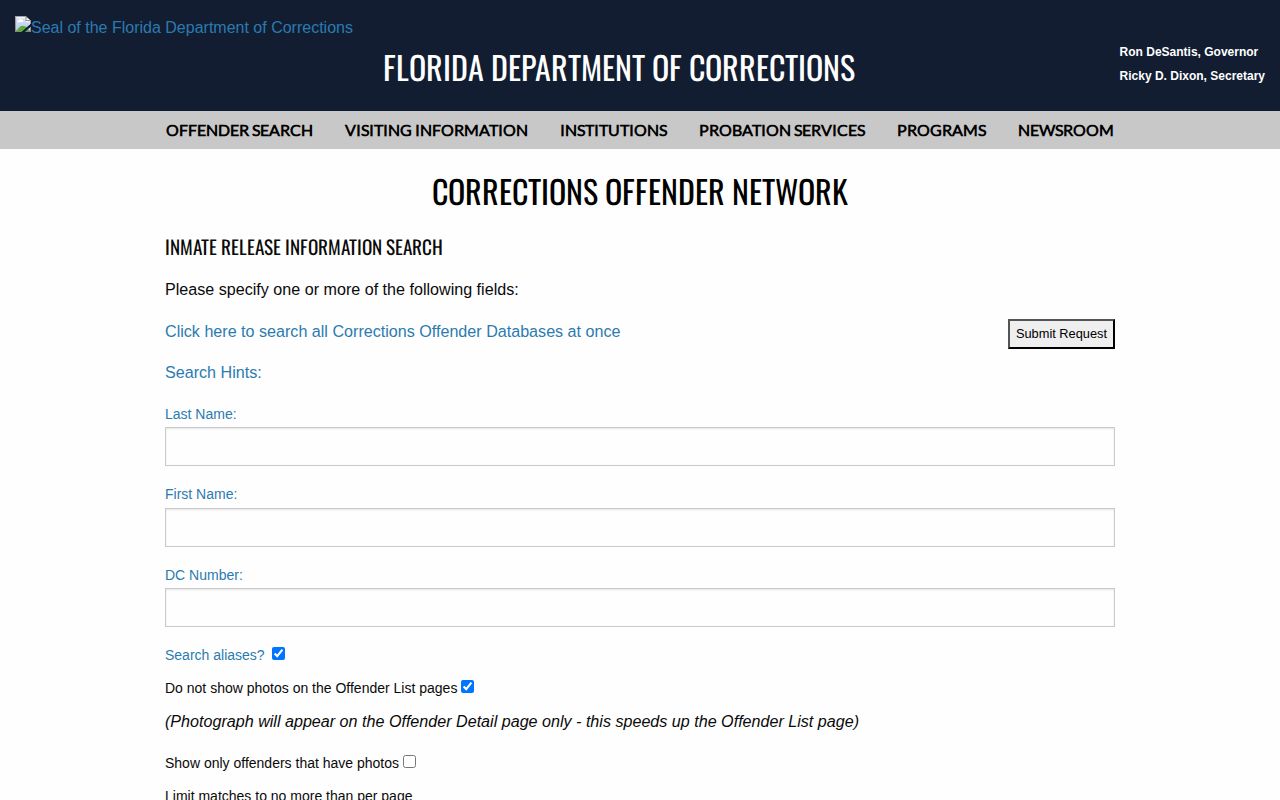
The form supports last name, first name, DC number, prefix matching, aliases, and added identifiers to narrow a result.
Florida’s Four-Search Release Chain
The Corrections Offender Network splits active incarceration, released incarceration, active supervision, and absconder information. That design is one of Florida’s most useful statewide traits. It permits a person to have a closed prison episode and a current supervision episode without treating the records as inconsistent. It also means one result rarely answers every question.
FDC says the release database includes people already released and people scheduled for release, with nightly updates. Its active population data refreshes weekly except release dates and location changes, which update nightly. Supervised-population termination dates and location changes also update nightly against a weekly refresh. Confirm that a listed date has passed and inspect the incarceration history before describing departure as complete.
The FDC Supervised Population Information Search is the next check after release.
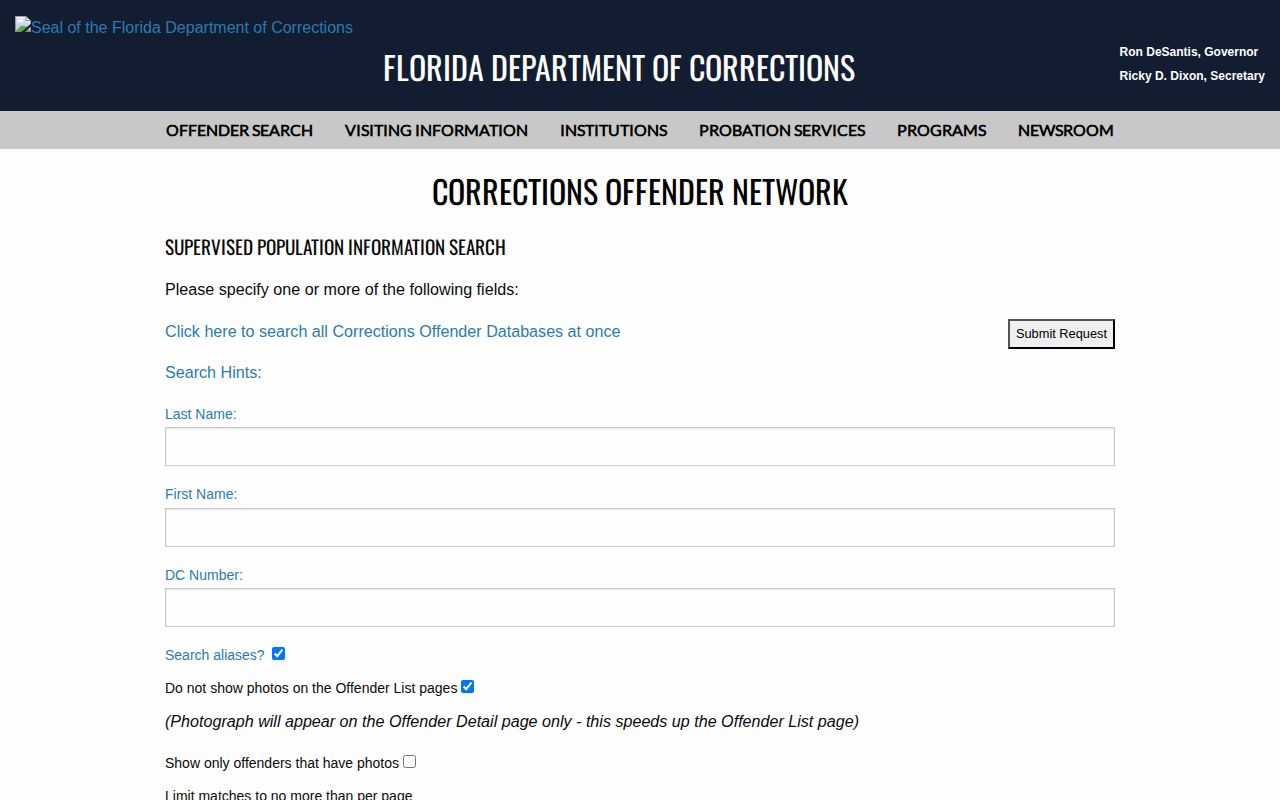
A supervision result can identify probation, parole, conditional release, community control, or another state-managed status after physical custody ends.
Florida Prison Release Scale
FDC’s January 2025 monthly report gives a dated view of the system: 87,978 people were in prison, 145,374 were under total community supervision, and 2,160 prison releases or expirations occurred during the month. Within the supervision total, 5,071 were on post-prison supervision. FDC defines that smaller group to include parole, conditional release, and program supervision, so the much larger probation population should not be mislabeled as parole.
These figures describe a month, not a live count. They show why release, probation, and post-prison supervision must remain separate measures.
Florida County Release Differences
Florida’s 67 counties do not publish one uniform recent-release feed. County research shows current-only rosters, short rolling release lists, booking logs with release fields, public-record fallbacks, and counties with no public archive. A statewide name search cannot replace the county that created the jail record. When the person never entered FDC custody, an absent FDC result may be correct.
The hierarchy is simple: use the county custodian and clerk for county custody, FDC for state prison, and the appropriate federal agency for federal or immigration custody. The county directory routes the local side without pretending every county interface works alike.
Florida Release Notification Checks
Florida VINELink offers a specific-person custody search and an alert-registration path. Enter the available name or identifier, select the matching custody record, and read the status and custodian exactly as shown. When the result offers a notification control, select the event and contact method, enter the required private contact details, and complete its confirmation or PIN steps. FDC’s separate victim-notification materials document Florida telephone and text options and use of a four-digit PIN for telephone notices.
VINELink is an alert layer fed by participating custodians. Timing, available events, and public fields can vary among Florida counties. It is not certified proof of legal release. A no-result should be checked against FDC, the county custodian, BOP, ICE, and the relevant court. Registration details are private and do not become part of the public custody record.
The Florida person-search screen shows the statewide starting point for a named custody check.
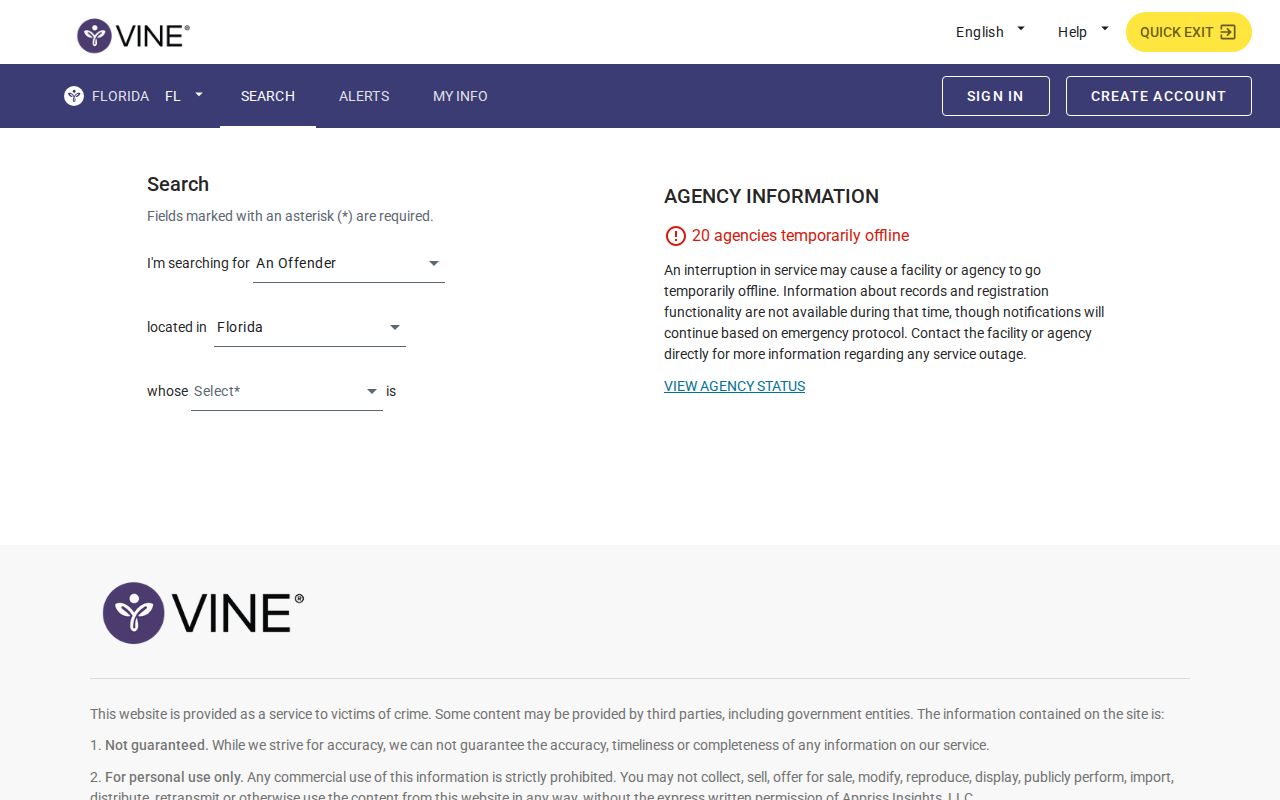
The matched agency record remains the stronger source for the date, release type, and destination when those details are needed.
Florida Release-Day Documentation
Release-day paperwork can prove a different point than the online status screen. FDC institution records may address the last custody transaction, property, funds, transportation, identification, or transfer. Florida Administrative Code Rule 33-601.502 provides a $50 discharge gratuity for an eligible person released on parole, sentence expiration, pardon, or permanent court order, subject to stated exclusions. A warden or designee may authorize up to $40 for an otherwise ineligible person when the rule’s conditions support it. Neither amount is universal.
Rule 33-601.503 separately governs discharge transportation. Section 944.605 adds specified pre-release notices, a digitized photograph near anticipated release, and help with identity documents. For qualifying Florida-born people released at sentence expiration, it addresses a certified birth certificate and state identification card or an appropriate replacement driver license, plus help when a Social Security card is needed. The last institution should confirm which duties and records applied to one person.
Florida Court Release Records
Florida’s Appellate Case Information System covers the Supreme Court and six district courts of appeal. It is not one name search for all circuit and county criminal cases. Most trial-level release orders, judgments, sentence changes, and violation cases remain with the clerk in the sentencing county.
The ACIS screen illustrates that limited statewide layer.
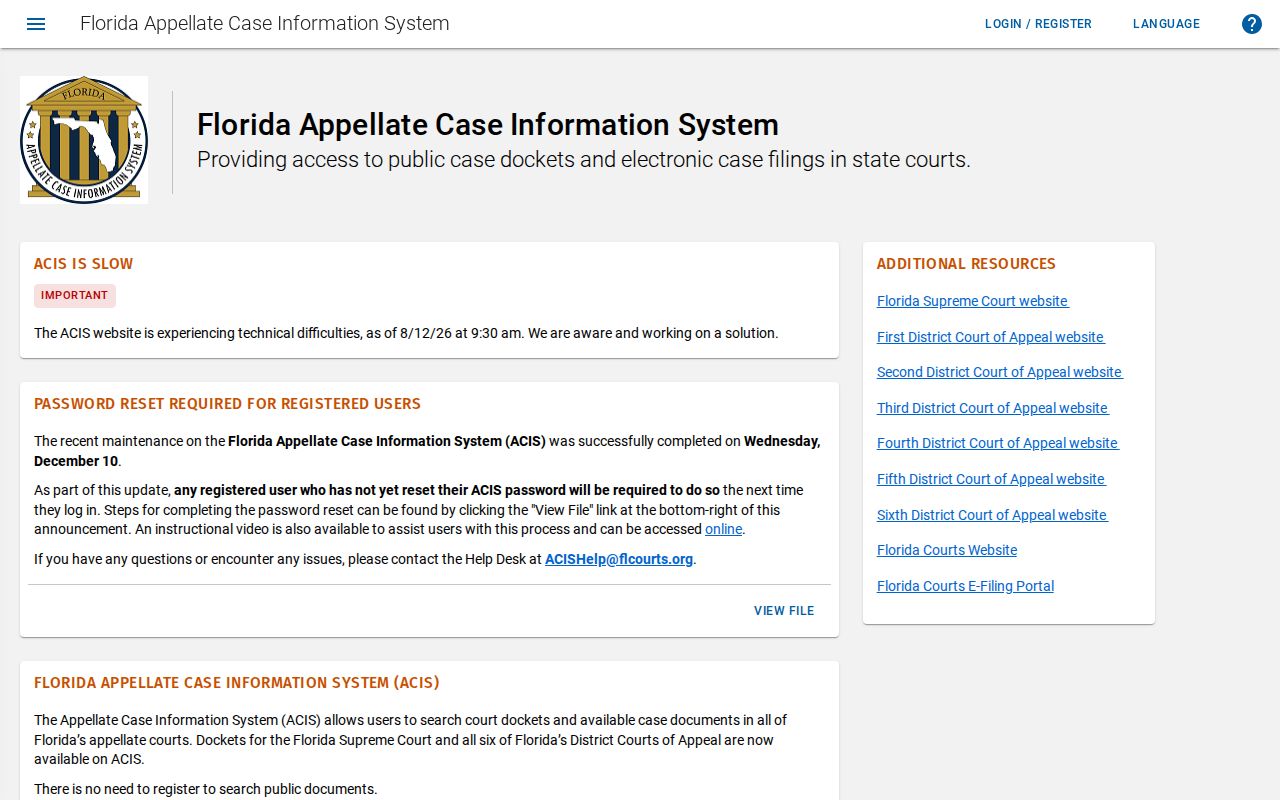
Use Florida Courts’ trial-court and court-location routes to find the correct clerk when the case did not arise in an appellate court.
Florida Federal Release Searches
The BOP Inmate Locator covers federal inmates from 1982 to the present and offers a separate route for older records. A historical result may show a release date and wording such as “Released” or “Not in BOP Custody.” That proves the end of BOP custody, not the end of federal supervision or the absence of a transfer.
The BOP form accepts federal register, DCDC, FBI, or INS numbers and name-based fields.
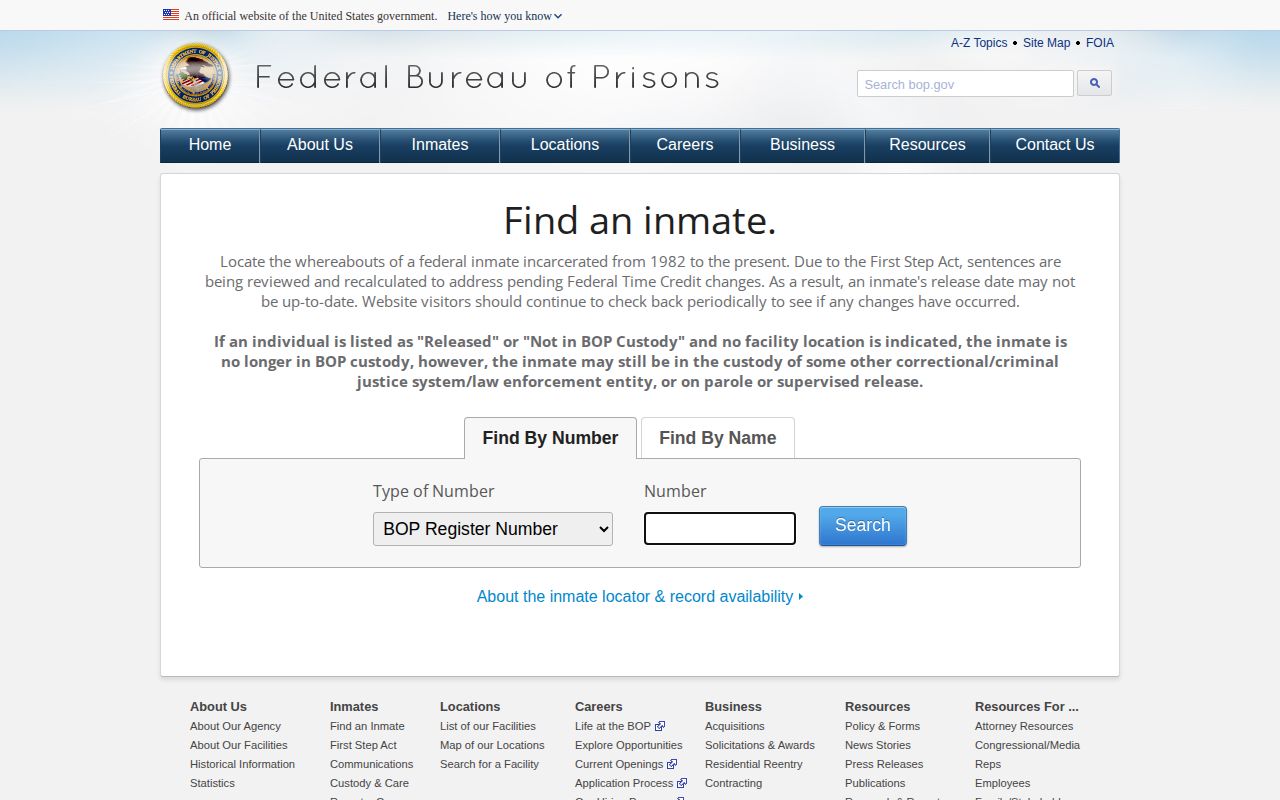
The federal docket and U.S. Probation may be needed to complete the status chain.
ICE’s Online Detainee Locator System offers an A-number and country-of-birth route plus a biographical route. Exact spelling matters, some people are excluded from public results, and no result does not prove release. A county-jail handoff to ICE is a transfer, not proof of release into the community.
Florida Discharge Proof
An FDC Release Date closes an incarceration event. A supervision termination or discharge record closes a different event. For a complete history, keep the release detail, check the supervised-population database, review any FCOR action, and obtain a termination certificate or order from FDC, FCOR, or the sentencing court when formal proof is needed.
Does a release date end all supervision? Not by itself. The separate supervision record answers whether another FDC-managed status continued after prison.
A formal request should name the endpoint that needs proof. Ask for the incarceration release document when the issue is physical custody. Ask for the supervision termination entry or certificate when the issue is the end of FDC monitoring. If an FCOR action controlled parole or conditional release, request the final commission action rather than relying on a meeting agenda. For a county case, seek the sheriff’s release record and the clerk’s controlling order. Keeping each request tied to one event helps the custodian locate an existing record and avoids asking one agency to certify another agency’s status.
| Status question | Correct source |
|---|---|
| Still in a Florida state prison? | FDC Inmate Population Information |
| Left FDC prison custody? | FDC Inmate Release Information |
| Under state supervision? | FDC Supervised Population Information |
| Reported as an absconder? | FDC Absconder/Fugitive Information |
| Left a county jail? | County custodian and trial-court clerk |
Note: Agency labels should be quoted exactly because custody end, supervision start, and sentence end are distinct events.